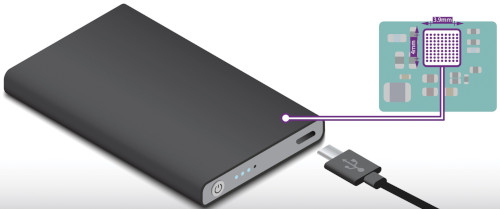
This USB-C buck charger provides the industry's first integrated USB-C port controller and charger to eliminate the need for a separate host controller, simplify software development, and reduce overall bill of materials (BOM) costs for applications such as financial point-of-sale terminals, power banks, industrial computers, scanners, radios, medical devices, charging docks, portable speakers, and game players.
A wide range of consumer electronics are migrating to USB-C interfaces to support communication and battery charging capabilities, as well as a smaller design footprint. In current designs, the host microprocessor is needed to detect the current level and configure the charger's input current limit. While PCs, laptops, and mobile phones have driven early adoption, USB-C adoption rates are expected to increase by 8.5 percent annually through 2020 thanks to its use in other classes of portable devices, according to IDTechEx.
To reduce design size and simplify system hardware and software design, the MAX77860 integrates USB-C configuration channel (CC) port detection and a 15W application battery charger. These built-in features enable battery charging at the fastest possible speed according to the USB-C specification and contribute to a 30% smaller design size, while also simplifying software development. The CC pin detection feature further reduces design effort by eliminating the need for end-to-end USB port connectivity and allowing charging to initiate automatically.
Key Advantages
- Highly Integrated: Eliminates a separate port controller and many discrete components. Reduces the size of an inductor and capacitor due to a high switching frequency of 2MHz/4MHz, resulting in a solution size that is 30 percent smaller than the closest competitive device. This high level of integration also reduces overall bill of materials costs.
- High Efficiency: High-efficiency performance reduces heat dissipation with over 93 percent efficiency and a load capacity of up to 3A.
- Design Flexibility: Backward compatibility allows designs to work with legacy USB-C and BC1.2 or proprietary adapters. The integrated analog-to-digital converter (ADC) frees up resources in the microcontroller while providing accurate voltage and current measurements.