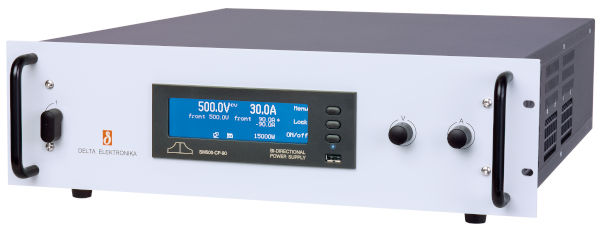
These programmable power supplies can function as both a power source and an electronic load. The energy absorbed as an electronic load is returned to the grid with 96% efficiency and a power factor of 0.998. The SM15K series is designed as modular units that can reach up to 900kW with the same performance as a single unit.
The SM15K family of power supplies from DELTA ELEKTRONIKA represented a significant technological leap by enabling a programmable DC power supply to operate in two quadrants: as a power source and as a dynamic load. This dynamic load functionality is achieved by returning the absorbed energy to the grid instead of dissipating it as heat, resulting in substantial energy savings. A third qualitative leap is the 96% efficiency of these energy conversions, eliminating the need for water cooling or overheating of cabinets and test rooms. The models include variants with full-scale ratings of 70V/450A for low-voltage applications and lead-acid batteries. The 500V/90A models are designed for electromobility and high-voltage batteries. For the renewable energy sector, the 1500V/30A models allow operation at the highest voltages with the necessary isolation, excellent ripple control, stability, and dynamic response. A new 210V/150A full-scale model completes the range for medium-voltage applications using 110Vdc batteries, widely used in the power sector. The power supply's performance is impressive, achieving a rise time of just 0.8ms in the 1500V models for a step from 10% to 90% of the voltage at full load. The fall times are a mere 2.8ms in this 1500V model.
These 15kW power supplies can also be connected in parallel with the master/slave module (models with up to 60 power supplies can be linked and managed as a single unit, reaching up to 900kW). The specifications in master/slave mode are virtually the same as those of the individual power supplies (e.g., recovery times of 250µs). Serial connection is possible in the SM500-CP-90 model.
The power supplies can be controlled via the standard Ethernet port or other protocols, as well as by analog signals that can be added using plug-and-play cards. This controller includes sequencer functions to execute predefined curves. For photovoltaic applications, UI curves can be loaded to simulate the behavior of a photovoltaic panel.