However, the latest models offer some significant advantages, as well as some novel and useful features that help reduce both setup and runtime, and provide greater control and flexibility for modern test setups.
The design priorities of modern electronic products are changing, and these changes are impacting expectations for laboratory power supplies. The growing trend in printed circuit boards to reduce product size and cost while adding more and more features is increasing the need for engineers to perform tasks such as device characterization and bench validation. Similarly, the increasing shift towards portable and battery-powered equipment is increasing the importance of accurate power consumption measurements. At the same time, the growing pressure to improve productivity and reduce time to market is driving engineers to seek greater value and capabilities in smaller, more user-friendly test equipment for tasks such as device characterization. Agilent Technologies and other leading manufacturers have analyzed these trends and launched the latest bench and rack-mount power supply solutions for service and development laboratory applications.
Precise Power Supply:
To meet the demands of offering smaller, more feature-rich, and more versatile equipment, the latest power supply ranges offer multiple independently adjustable output channels with individual protection thresholds. These units enable engineers to meet most power requirements for general-purpose applications using a single power supply. This not only saves bench space but also reduces setup time and avoids repeated power supply readjustments during successive testing of new boards.
Multiple output channels allow the power supply to be connected to modern boards that often have several power sectors operating at different voltages to, for example, power electronic components, analog voltage devices, or products with independent I/O and logic voltages. The latest models offer a significant advantage over many older types by providing greater flexibility in overvoltage and overcurrent protection functions. Power supplies that allow independent overvoltage and overcurrent configuration for individual outputs enable engineers to power boards without having to use multiple power supplies.
Agilent's latest innovations include robust fault detection features and guaranteed specifications for bench, modular, and application-specific power supplies, giving engineers confidence in the latest equipment.
Another example demonstrates how the latest innovations can automatically protect devices under test in the event of a fault. The fuse function included in Hameg's range of laboratory power supplies allows boards to have interdependent power supply sectors. For example, in a motor control system, if a short circuit causes the drive power supply to shut down, it is desirable that the auxiliary power supply also shut down. The power supply can be programmed to disconnect these two units while continuing to power the driver board, thus allowing the circuit to continue being tested.
 Furthermore, with the rise of renewable energy sources, more and more engineers need to be able to test devices such as solar panel assemblies. Power supplies like Hameg's HMP series meet this growing demand by allowing users to create complex, cell-specific V/I profiles. The ability to simulate events such as voltage dips or spike injections, or to individually program current-versus-time behavior for any channel, also enables engineers to create highly reliable tests for battery charging circuits.
Smaller is better.
To save desktop space and help engineers work more efficiently, Hameg has designed its range to allow engineers to use a single power supply to meet 85% of their everyday general-purpose power requirements. The HMP family consists of four units, offering two- and three-channel configurations in 200W and 400W versions, capable of delivering up to 40A of current. This approach will allow some companies to offer cost-effective power supplies directly to every engineer's desktop. This could eliminate the need to retrieve and return equipment from warehouses and help companies avoid accumulating large quantities of different types of power supplies.
On the other hand, buyers with diverse needs require flexibility and choice. Agilent, for example, can offer more than 200 configurations, including benchtop DC power supplies such as the 601X, 603X, 606X, 65XX, and 66XX single-output families, as well as the N5700/N8700 high-power compact power supplies in a wide variety of standard U-profile sizes. This is one of the broadest product ranges in the industry, designed to meet as many customer needs as possible.
With units rated from 30 W to 6.6 kW, Agilent's offering recognizes the increase in typical power ratings of electronic equipment, especially in processing, communication, and networking products that must offer enhanced features such as higher speed, channel density, or wireless range to meet the increasingly demanding needs of end-user markets.
Improving Usability:
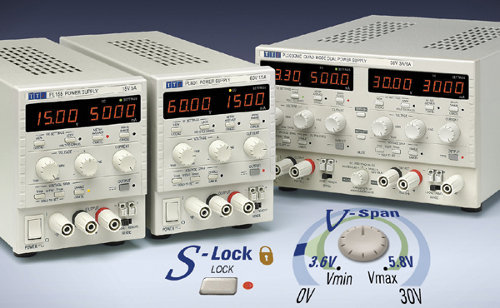
Most printed circuit boards operate at lower voltages than previous generations. For laboratory power supplies, more precise control is needed to maintain stable voltage and current below nominal levels. Thurlby Thandar Instruments (TTi) has responded to this new requirement by focusing on user interface improvements that help engineers achieve valuable increased control over their devices. The user interface of TTi's new PL series power supplies, for example, has been designed to meet customer demand for equipment that combines the stability of digital control with the simplicity and speed of traditional analog control knobs (Figure 1). These power supplies feature genuine analog control knobs but also include an internal digital circuit to lock configured voltage and current values at the push of a button, providing optimal stability and safety. Another important digital feature allows users to define the output voltage adjustment range. The device also configures the automatic response of the control knob so that one full turn of the knob covers the entire range selected by the user. This function, called amplitude V, allows engineers to create a voltage source that can be adjusted to a very small range, if necessary.
Low operating voltages also require more precise control of current and voltage regulation. This is especially true for sensitive devices such as laser diodes, where small current fluctuations have a significant effect on the intensity of the emitted optical signal. In these situations, it is essential to maintain a very low ripple voltage, even with high current output, to enable consistent control of the device under test. The latest innovations from leading manufacturers are designed to meet all three requirements of modern components; Hameg, for example, offers a ripple voltage of less than 150 µV in its HMP series, even with load currents exceeding 10 A.
Mixed-Mode Regulation:
In the design of integrated or board-mounted power supplies, smaller, more efficient switching topologies have replaced linear regulators in most applications. However, in the realm of laboratory power supplies, the high accuracy and relatively low output noise of linear regulators are highly valued. Even so, the goal of delivering ever-increasing power and adding new features in compact housing dimensions is met by using switched-mode regulation.
To achieve this, power supply manufacturers have implemented mixed-mode regulation to offer the best principles of both linear and switching regulators. In AC applications, a compact switching regulator offers more efficient mass power conversion. In DC output channels, however, precision linear regulators are used to produce a precise, stable voltage free of switching harmonics that could otherwise only be eliminated by resorting to impractical levels of filtering. Most power supply manufacturers offer power supplies with mixed-mode architectures.
TTi has further developed this topology for its PowerFlex range, which uses a modified form of mixed-mode regulation to provide higher current levels when the voltage is set to low values. This is a very useful feature in high-performance and advanced power systems, such as motherboards and rackmount cards populated with low-voltage processors.
Value-Added Functionality:
Other advantages of next-generation laboratory power supplies include integrated additional capabilities that provide added value and reduce the number of individual devices engineers must use on their desktops. By leveraging digital-level configuration circuitry, including precision analog-to-digital converters (ADCs), the power supply can also offer precision digital multimeter (DMM) capabilities equivalent to standalone 4- or 4.5-digit instrumentation equipment. By offering such a device for each output channel, these power supplies allow engineers to clear multiple pieces of equipment from their desktops and accelerate data collection from the device under test. Some power supplies offer the advantage of integrated memories, especially for capturing measurements taken from the device under test.
Continuing with the theme of value-added integration, Agilent also offers the N6705A DC power analyzer (Figure 2) with up to four power modules providing a total of 600 W of power, combined with 18-bit accurate voltmeter and ammeter functions, digital range, data logging, and a large-capacity non-volatile memory for recording data, traces, and configurations. The productivity benefits achieved through these capabilities are why the N6705A has garnered more industry awards than any other Agilent product, including accolades from six leading industry magazines and the International Engineering Consortium's (IEC) 2008 Design Vision Award.
Conclusion:
While classic equipment has its appeal, engineers risk underestimating the contribution that modern laboratory power supplies can make in improving efficiency, enhancing test design and execution, saving on capital investment, and ultimately reducing time to market for new product generations. This article has highlighted the importance of innovative design that brings all these advantages to engineers' desktops, a common theme in new product releases from leading manufacturers.
Author: Emily Reed, Product Manager, RS