

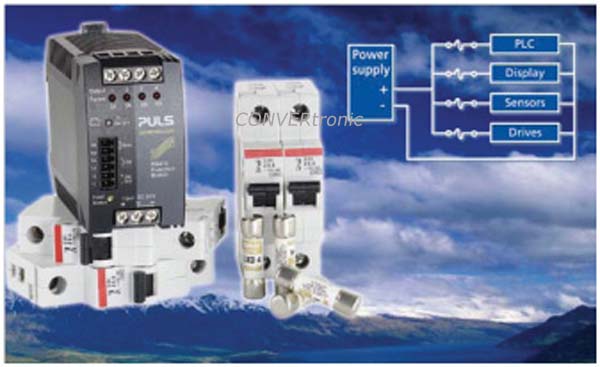
The operation of PISA smart electronic fuses is as follows. We have a 24VDC power supply. Critical loads, such as a PLC, are directly connected to the output of this power supply, ensuring that their power supply is never interrupted.
On the other hand, we will connect the PISA electronic fuse to the power supply output and to the PISA module output for non-critical loads (Figure 1). The PISA smart and safe electronic fuse works in two ways.
First, if one of the loads connected to a PISA channel exceeds the current rating of that channel, the current passing through it will be limited for a short time. This prevents the need to disconnect the channel, which could be due to a startup surge or other temporary problem. In the event of a short circuit or a problem in a branch connected to the fuse, the current is limited for a few milliseconds. If the problem persists, all loads connected to the electronic fuse will be disconnected. This prevents a problem in a non-critical load, such as a motor, relay, or display, from causing the core and control system of our application (control PC or PLC) to fail.
It also allows us to reduce the cable cross-section required for each branch. For example, if a 10A power supply can short-circuit and deliver 15A, even if we have a branch circuit with a 1A load, we should have a cable cross-section designed to handle 15A. In the event of a short circuit in that branch circuit, the cable cross-section must be able to withstand the full current that the power supply can deliver, or it will catch fire.
However, this is already performed by other electronic fuses on the market. The most novel and innovative feature is the voltage control for critical loads.
At the input of these modules, there is a safety circuit that acts as a valve, allowing only the maximum current possible to pass through, provided that the input voltage (corresponding to the power supply) does not fall below 21V DC. This ensures that critical loads connected directly to the power supply always receive an adequate supply voltage.
Puls power supplies, in the event of a short circuit or overload, reduce the supply voltage while maintaining a constant output current (this allows them to handle startup surges, charge batteries, etc.). Therefore, when we increase the load on a power supply and exceed its capacity, the voltage begins to decrease. This intelligent fuse system limits the current flowing to your loads to prevent the supply voltage to critical loads from causing them to shut down. The reason for using electronic fuses is to ensure proper power to our critical loads, whereas conventional systems only monitor the current flow.
In a power supply, for example, a 24V 10A supply, we often connect several loads, and we frequently need to adjust the fuse ratings for each branch to accommodate starting current spikes or occasional load surges. For example, imagine we're connecting a PLC that draws 1A and two 4A motors to this supply. We would likely need to install a conventional fuse of 5 amps or more for the motors to allow for certain switching operations and starts. It's possible that both motors might draw 5A and the PLC 1A, for a total of 11A.
This exceeds the capacity of our power supply, which could shut down and disconnect everything, including the PLC, since the current rating of any individual fuse in each branch hasn't been exceeded, but the power supply's capacity has. This cannot happen with PISA smart fuses. Even if we don't exceed the maximum current, if the system detects that the supply voltage to critical loads is at risk, it limits the current, allowing only as much current as possible to pass through without endangering those loads. In our case, even if the motors required 5 A, it would only supply them with 4.5 A, plus another 4 A for our PLC. This is an innovative and revolutionary system that greatly simplifies the work. There's no longer any need to verify that the theoretical current calculations for each branch are correct, no need to precisely adjust the value of each channel to match our load, and the intelligent PISA electronic fuse will prevent any problems with our critical loads.
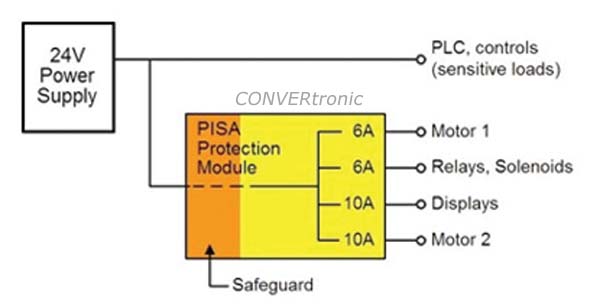 Less critical loads that are not affected by short-circuit interruptions or that could even be the cause of a failure in the 24V power supply, can be connected to one of the four output channels of the PISA module, thus being monitored and limited.
Two protection measures in a single module
- First Protection: Prevents voltage drops by monitoring the input voltage. Unique to Puls.
- Second Protection: Prevents overheating in cables caused by short circuits and monitors output currents.
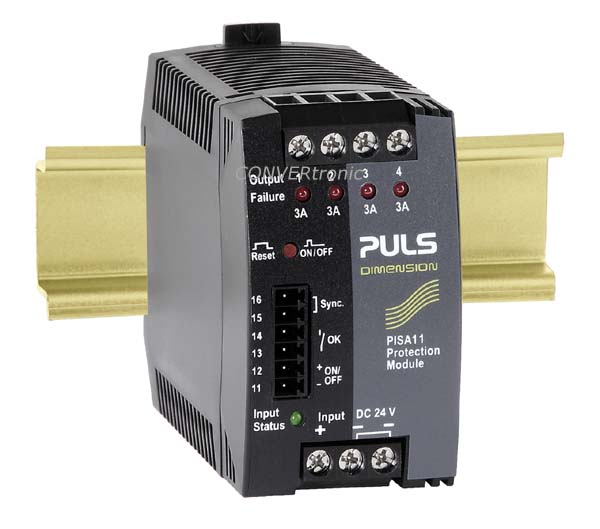
Puls protection modules, PISA, have a 24V input and four output channels to distribute the current. The current in each channel is measured electronically, and all outputs are disconnected in case of overload or failure. The module then always indicates which specific channel has failed, quickly identifying the problem. (Figure 1).
If you require more than four output channels, you can use multiple PISA modules with the same power supply.
When the synchronization lines are connected to each unit, the entire set of PISA units will act as a single module. If the failure is due to overcurrent on a specific channel, only that module will be isolated. However, if the shutdown is due to an overall overcurrent that threatens the power supply, all synchronized modules will shut down. This indicates that the failure was not caused by exceeding the maximum current assigned to a specific channel, but rather by the entire load.
PISA modules are only 45mm wide on the DIN rail. These modules are not sensitive to small overload spikes, and thanks to an active protection circuit, current spikes caused, for example, by capacitive loads, will not trigger the equipment's protection. This is because they can be electronically limited to prevent any problems, while still being able to start large capacitive loads or devices with high starting currents.
 These modules are very easy to use. Their integration into machines and other systems is very simple, with virtually no risk of sizing or incorrect planning. Modifications, adaptations, or expansions to the systems where they are integrated also present no major obstacles. In many cases, smaller power supplies can even be used since they do not require the additional current typically needed by other electronic fuses on the market.
A relay contact indicates whether an output has been switched off, and the module can be reset from the device itself or remotely by applying a voltage to the input signal.
In addition, the cost of a PISA module is about half the cost of 4-channel electronic fuses on the market and only slightly higher than the total cost of 4 traditional miniature circuit breakers with an auxiliary contact.
Permissible voltage range:
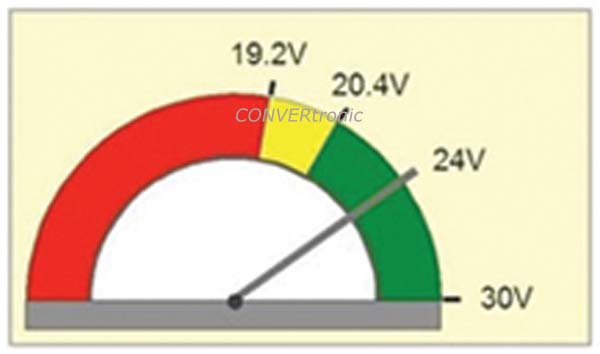
According to IEC/EN 61131-2, voltage fluctuations or drops below 20.4V are not permitted in 24V supply voltages.
The range from 19.2 to 20.4V is only permitted as AC ripple overlay voltage. (Figure 2).
 Voltage Interruptions:
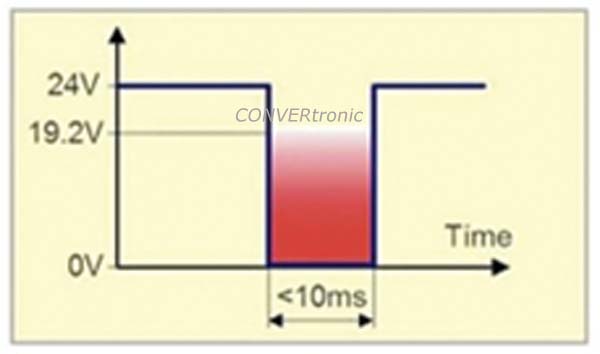
PLCs and other control equipment must not exhibit malfunction during voltage interruptions of up to 10ms, in accordance with IEC/EN 61131-2. (Figure 3)
As we can see, the concept of safety for 24 VDC systems is not as simple as initially suspected. A traditional approach with single-channel fuses will work, but it's more expensive. It's advisable to opt for selective switching of the different branches. In many cases, we can save money with the new PISA PULS module without having to take risks.
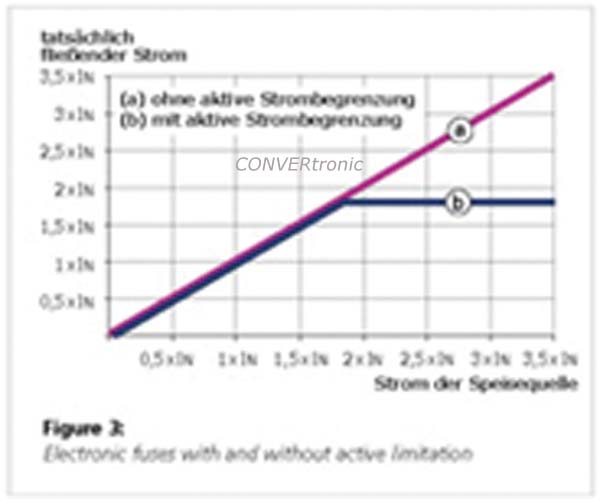
 Electronic fuses can be equipped with or without active current limiting (Figure 3). The basic model only includes current monitoring with subsequent shutdown at the output. This concept allows for a more cost-effective design but places a greater load on the power supply as well as "uncontrolled" current flow in the faulty branch. A very rapid interruption is necessary to avoid excessive voltage drop.
As we can see, the safety concept for 24 VDC systems is not as simple as initially suspected. A traditional approach with single-channel fuses will work but is more expensive. It is advisable to opt for selective interruption of the different branches. In many cases, we can save money with the new PISA PULS module (Figure 4) without having to take risks.
OLFER is an official distributor of PULS.
Author:
Michael Raspoting, Puls