
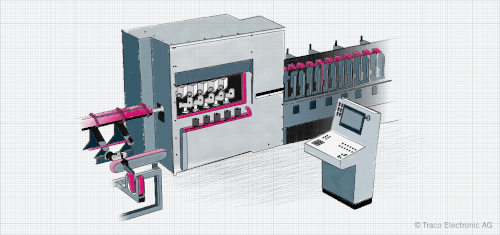
What's fascinating about industrial systems is the continuous and rhythmic execution of their tasks, working in harmony to assemble products, prepare food, build vehicles, and handle materials. Ensuring these systems remain operational 24/7 is no easy feat. And behind every PLC, actuator, and sensor, a power supply is needed to guarantee continuous power availability. So, how do you select a power supply that will operate reliably under the demanding conditions industrial systems face?
Industrial machines need reliable power supplies to process materials and manufacture products.
How is the required input voltage specified?
The starting point for determining the optimal power supply revolves around three technical parameters: input voltage, output voltage, and output power. If you are building a machine that will be permanently installed on your site, this is defined by the power supply to which the machine is connected, for example, 230 VAC single-phase at 50 Hz.
However, if you are building equipment for export worldwide, you will need to consider the different power grids your customers may have. In these cases, you can specify a universal AC input. This ranges from 85 VAC to 264 VAC and supports frequencies between 47 and 60 Hz. Although alternating current is typical in industrial systems, there may be instances where only a direct current (DC) supply is available. Some power supplies also support a DC input with a range similar to the AC input, thus covering these eventualities.
What should be taken into account regarding the power supply output?
Once the input voltage options are clarified, it's time to analyze the output requirements. These are determined by the equipment being powered, such as industrial sensors, PLCs, and actuators like servo drives. For example, although most PLCs define a supply voltage of 24 VDC, they can typically tolerate a variation, including ripple, of around ±20%.
Some power supplies offer two or three different output voltages, typically directed to common voltages or positive and negative outputs. If the desired voltage is not available, two power supplies can be used in series to achieve the desired output. Two power supplies of the same model and output specification must be used.
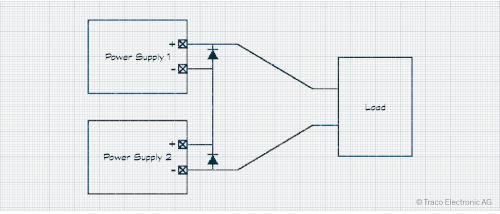
Figure 2: Antiparallel diodes
Connecting multiple power supplies in series can result in a higher output voltage, but it is recommended to use antiparallel diodes to prevent reverse voltages if the startup times differ.
Most loads have a typical and maximum current draw, such as 80 mA and 100 mA. When powering multiple loads, the sum of the worst-case maximum currents must be calculated. Using the power equation, P = I × V, you can determine the required output power. For example, if you plan to power five of the PLCs described, you will have a current draw of between 400 mA and 500 mA, or a power requirement of between 9.6 W and 12 W at 24 V DC.
If you don't have a power supply with sufficient wattage, you can use two or more in parallel to obtain the combined power. However, you should limit yourself to consuming no more than 80% of the total available power. Factors such as temperature and aging can also cause premature aging of one of the power supplies, which could stress the unit and lead to failure. Choose power supplies of the same model that operate at the same voltage or select units designed to work in parallel. If in doubt, it's advisable to contact the manufacturer.
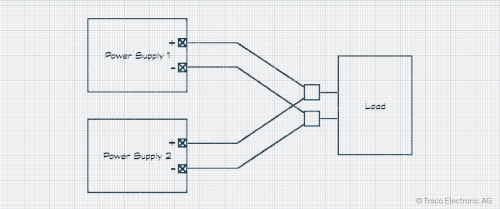
Figure 3: Power supplies in parallel
Power supplies can be connected in parallel. Ensure both outputs have the same voltage.
Consider the mounting, cooling, and termination options for the power supply.
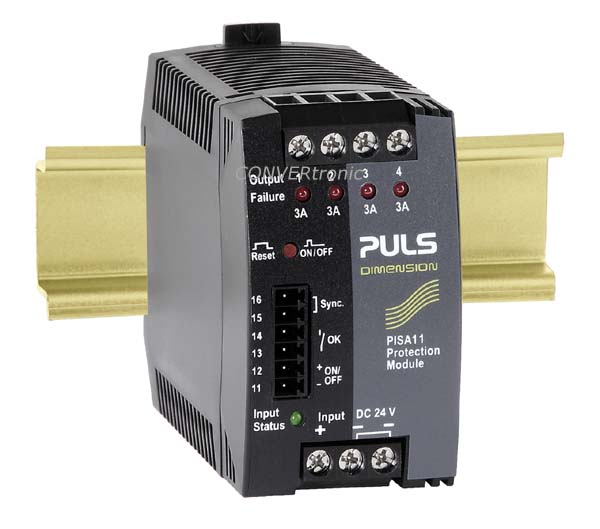
In some situations, the application defines the mounting and cooling requirements of the power supply. For example, DIN rails or Hutschienen are a standard mounting option for PLCs and related equipment, so a DIN rail power supply is your best choice.
There are units up to 600W with convection cooling, so forced ventilation isn't a concern. In fact, industrial power supplies avoid forced cooling altogether, as it represents another potential point of failure. However, adequate airflow for natural convection is necessary, with 20 LFM (linear feet per minute) being a typical specification.
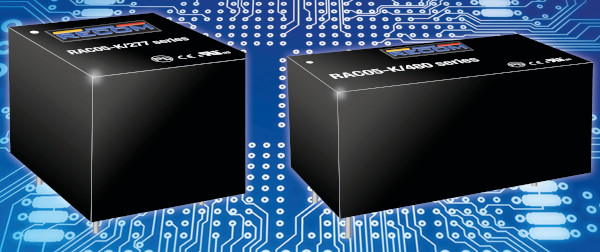
Other power supplies come in a metal housing with chassis mounting brackets, allowing them to be installed in the application with screws. Finally, if you are building an industrial application at the component level, you will be interested in printed circuit board (PCB) mounted power supplies. These can be open-frame, without a housing, or protected by a plastic enclosure with an encapsulating compound.
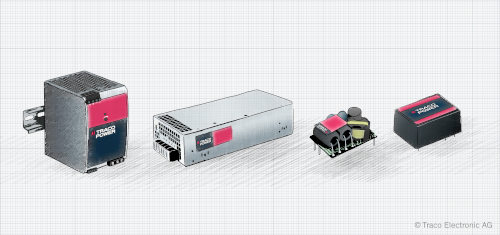
Figure 4: Power supply housing
Power supply enclosures vary from DIN rail (far left) and chassis (left) mounts to open-frame PCB (right) and plastic (far right) mounts.
The mounting type and intended application often lead to specific termination options. DIN rail and chassis mount power supplies typically offer screw terminals, allowing technicians to easily wire the unit. Adapters are also available for attaching chassis mount power supplies to DIN rails. For PCB mount units, you will need to consult the datasheet drawings for pin spacing and dimensions. Regardless of the type you choose, most vendors also provide CAD drawings that can be imported into your design software, helping you avoid placement issues when building your equipment.
Ensure that the power supply meets environmental conditions and industry standards
If your system is regularly subjected to vibration or physical shock, you'll want to check which standards it meets. These environmental factors are covered by standards such as EN 61373 and parts of IEC 60068-2. You should also check the specified operating temperature range and non-condensing relative humidity. Power reduction at higher temperatures and lower input voltages may also be defined.
UL 508 is another important standard for industrial control equipment. This standard ensures compliance with standard overload, dielectric strength, short-circuit, and fault current tests, as well as a number of other essential criteria. Compliance with these standards guarantees that the power supply meets the safety, reliability, and longevity requirements of industrial applications.
If you need to delve into the details, you will usually find application notes with information on thermal considerations, EMC test results, output voltage adjustment, and characteristic curves.
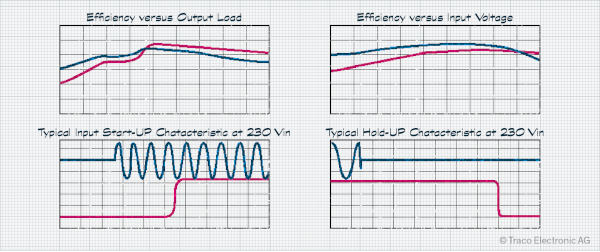
Figure 5: Application Note
The application notes provide more details than the power supply data sheet, such as efficiency as a function of load/voltage, startup and hold characteristics.
How to specify an industrial power supply tailored to your needs
Finally, while manufacturers cover most everyday industrial power supply needs, there will always be cases where exactly what you need isn't available. In these situations, there are two options. Sometimes, it's possible to adapt an existing design or obtain additional certification to meet your requirements. Otherwise, you could consider a custom design. In these cases, you'll need to gather all your requirements and share them with your chosen partner to begin the design process.
Author: Simeon Tremp, Traco AG