

However, we are now witnessing a new and enormous technological advance: the deployment of wideband semiconductors (WBSCs). Gallium nitride and silicon carbide have been used for years in radio power amplifiers and high-voltage diodes, but it is only in recent years that they have become part of the power switching chain in the form of transistors. Adopting a new technology is fraught with challenges, which, surprisingly, are not always technical. Learning is an important part of the path to success, but market adoption and building a new ecosystem are far more complex than they might initially seem. Let's examine where WBSC currently stands and what challenges remain.
The pioneers drove the adoption of GaN.
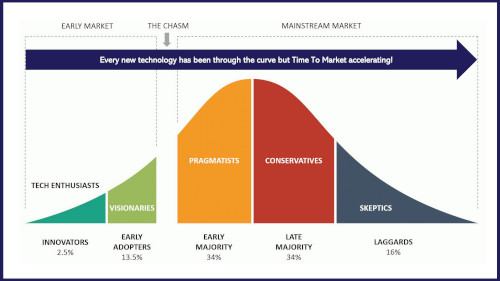
Inevitably, for new technologies, the time-to-market is a long process, and from the initial research, obtaining patents, introducing the technology, and its market adoption, it could take more than 10 years. We are all familiar with the camelback curve (Figure 01), and for those of us who fall into the category of technology enthusiasts, the success of a new technology will come from the pragmatists and conservatives.
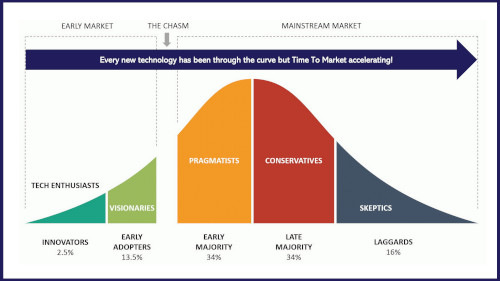
Figure 01 - Experienced power designers have crossed that technological chasm many times and the adoption of GaN follows the same pattern (Source: PRBX/Geoffrey A. Moore)
Introduced in 2005, digital control in power supplies has been widely adopted, but after 20 years it is still considered a curiosity by skeptics. Under normal circumstances, the same would have happened with the adoption of WBG, but market demand for smaller, lower-power supplies, industry modernization, emerging technologies, and the now-famous Artificial Intelligence have all contributed to accelerating the learning and implementation processes.
As the Applied Power Electronics Conference (APEC) celebrates its 40th anniversary, it's worth remembering that, for many technology analysts, the cornerstone of GaN was established at APEC-2018, when the "aspirants" demonstrated the commercial potential of GaN technology. It's not possible to name them all, but among the leaders who championed GaN, I would say that Efficient Power Conversion's (EPC) idea of implementing GaN in LiDAR was particularly interesting, especially with that technology becoming prevalent in the new generation of vehicles (Figure 02).

Figure 02 - GaN laser diode control in nanoseconds for advanced autonomy in automotive (Source: PRBX courtesy of Efficient Power Conversion (EPC))
LiDAR, short for Light Detection and Ranging, is a technology that uses laser pulses to map an environment. When a pulse strikes an object or obstacle, it is reflected off the LiDAR unit. The system then receives the pulse and calculates the distance between itself and the object based on the time elapsed between the pulse's emission and the reception of the returning beam. LiDAR systems are capable of processing a large volume of pulses, with some emitting millions of pulses per second. By processing the returning beams, the system generates a comprehensive view of its surroundings, allowing sophisticated computer algorithms to be used to discern shapes and identify objects such as cars and people.
Due to its high-frequency operation, which allows for faster laser pulse modulation, LiDAR applications were among the first to adopt GaN technology. Its ability to handle high currents with minimal losses is paramount for improving accuracy and extending the range of LiDAR systems. GaN's advantages in terms of efficiency and power density enable the development of smaller and lighter LiDAR systems, making it a suitable solution for diverse applications such as automotive, security, robotics, drones, and aerospace. Behind the scenes, the development of LiDAR applications has contributed to the adoption of GaN and is now representing a significant volume.
2018 was also the year USB adapter manufacturers began considering implementing WBG technology to deliver more power in a smaller package and gain a competitive edge. I've mentioned EPC, but Navitas Semiconductors is another example of an innovative company that early on pushed GaN integration to a higher level by packaging drivers and switches on the same substrate.
Simplifying complexity: the key to success!
When first introduced, the use of WBG power semiconductors was limited by the number of available drivers, making it difficult for power designers to consider this technology. Furthermore, new technologies are always questioned regarding reliability and sustainability. Market adoption depends on how easy it is for power designers accustomed to conventional MOSFETs to use WBG, and on how quickly semiconductor manufacturers can develop "off-the-shelf" solutions that include driver, protection, monitoring, and many other functionalities on a single chip. This not only simplifies implementation but also reduces the overall size of the power stage and, combined with higher switching frequencies, allows for smaller magnets, thus increasing power density while simultaneously reducing the overall volume and mass of the power supply.
As we've already mentioned, among the many products that could benefit from the implementation of WBG technology, laptop chargers stand out. As end users, we all expect USB chargers to deliver more power, charge faster, and be smaller and lighter.
In 2020, this wish became a reality, and an example of the advantages of using GaN WBG to achieve this is a 110W Mini Fast Charger that is more than 12 times smaller than the 96W charger supplied with the Apple MacBook Pro 16 released by OPPO (Figure 03).
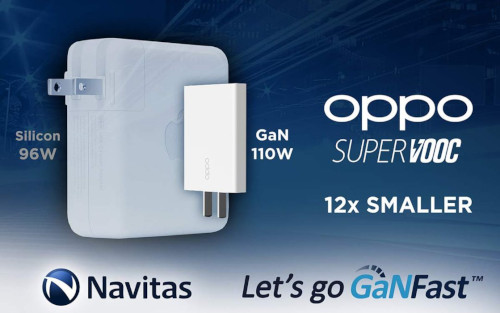
Figure 03 - The implementation of GaN in USB-C chargers allows for a reduction in size and weight while increasing power density and efficiency (Source: PRBX courtesy of Navitas Semiconductor).
This was made possible by combining Navitas GaNFast power integrated circuits with a planar transformer, an optimized topology, and a higher switching frequency. Simultaneously, EPC released a GaN IC that integrated all these features, allowing power designers to easily implement it in their new designs (Figure 04).
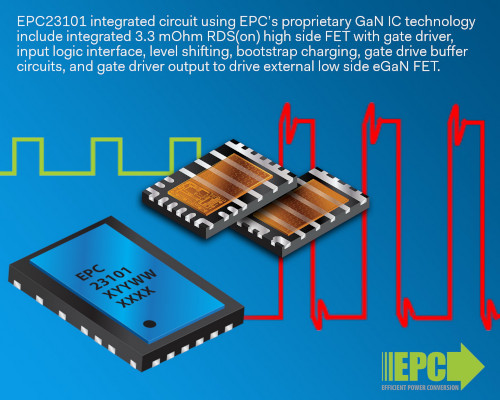
Figure 04 - The EPC23101 integrated circuit, which uses EPC's proprietary GaN IC technology, simplifies design (Source: PRBX courtesy of Efficient Power Conversion (EPC))
These examples illustrate how WBG GaN manufacturers quickly moved from "complex" to "simple" to implement the technology, helping to generate volume and adoption in the market.
High-power GaN lays the foundation for the future.
As we've seen, driven by the consumer segment, power designers quickly realized the advantages GaN offered for delivering more power in smaller form factors. Power designers faced several challenges in developing high-frequency switching using GaN technology in very compact formats, but it was a truly exciting time for many of us.
The examples presented referred to low and medium power applications, but the WBG also generated great interest in high power applications, such as electric vehicles, renewable energy, and many others.
Electric vehicles (EVs) have seen significant adoption of WBG technology, and today it is the dominant technology in battery chargers, powertrains, and, as previously mentioned, equipment such as LiDAR. EVs are often presented as the showcase for WBG adoption, although the role of information and communication technologies (ICTs) in supporting GaN and SiC research is less well known.
The goal of this research was to develop the next generation of power supplies to support hyperprocessor and data center applications for Artificial Intelligence (AI). The rapid adoption of AI is accompanied by significant growth in data volume and increased computing requirements. By 2025, data volume is projected to reach 180 zettabytes, up from 15 zettabytes in 2015. According to OpenAI researchers Dario Amodei and Danny Hernandez, the amount of computing power used for deep learning to train next-generation AI models has doubled every 3.4 months since 2012. This continuous increase in computing power directly impacts electricity consumption, with AI data centers projected to account for up to 7% of global electricity demand by 2030.
Optimizing energy use has always been a concern for ICT manufacturers, who require all suppliers, from infrastructure to components, to reduce energy consumption. From the early days of research to improve the energy efficiency of AC/DC or DC/DC power supplies, power electronics designers explored new technologies and partnerships with semiconductor manufacturers. Several papers have been presented at APEC and other conferences. Navitas Semiconductors deserves mention; at APEC 2022, they presented "Electrify Our World," introducing the benefits of GaG in ICT and, in 2024, the implementation of this technology in data center power supplies, where they predicted that the power demand per unit would eventually reach 10 kW (see Figure 5).
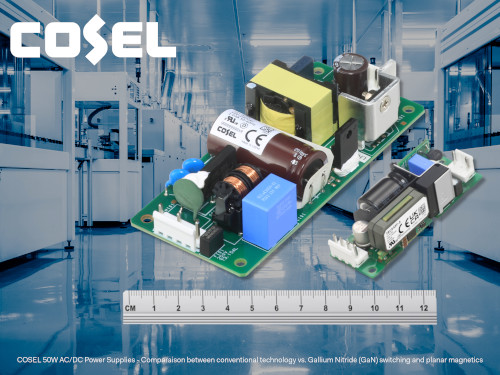
Figure 06 - COSEL industrial power supplies that adopt GaN and integrated magnetism facilitate their integration into small spaces (PRBX/COSEL Power Supply)
Exploring the optimal advantages of combining GaN and SiC, the company launched an 8.5kW, 98% efficient reference design that meets Open Compute Project (OCP) and Open Rack v3 (ORv3) specifications and is ready for stringent energy efficiency standards (Figure 05). This is a good representation of what can be achieved by combining WBG and other advanced technologies to power current and future ICT applications, and more is expected.
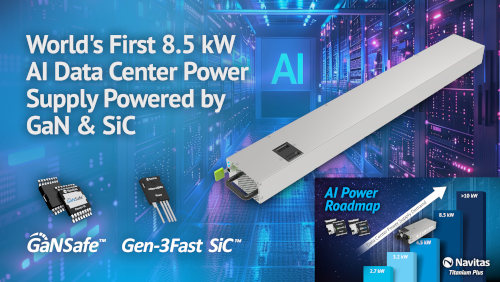
Figure 05 - WGB contributes to the efficient supply of energy for AI data centers (Source: PRBX courtesy of Navitas Semiconductor)
Industrial applications in transition mode.
LiDAR, USB chargers, and ICT represent a significant part of the market, but other sectors such as industry, rail, and medicine are also investigating the advantages of this technology, although they have some doubts about the reliability and availability of the new technologies.
According to market analysts, although GaN has been on the market for several years, it remains fragmented, with each GaN manufacturer offering different combinations of products and services targeted at specific segments. To get the most out of GaN, power designers must work closely with semiconductor manufacturers and adopt comprehensive solutions (GaN transistor, driver, protection, etc.) sourced from a single supplier, even though the risks of using products from a new vendor with a limited track record and financial backing are a concern. This is to say nothing of applications such as railways, which require a 25-year lifespan and product availability for maintenance, making a robust and sustainable supply chain a crucial part of the complex equation when considering a new technology.
As a result, adoption in industrial, rail, and medical applications may be slower than in EVs, ICT, and consumer electronics, but the clear benefits of WBG have motivated designers to explore this avenue. One example is the result of COSEL's research combining digital control, GaN, and planar magnetism, which allows for very compact power solutions that are easy to integrate into confined spaces (Figure 06). This will allow the power supply and a backup battery to be housed in the same volume as a conventional version of a similar power supply. As we move toward new applications requiring higher performance, WBG will gain market share and follow the same path as the pioneers.
Conclusion:
Many of the challenges power designers faced when WBG technology was introduced eight years ago at APEC have been overcome, and there is no doubt that GaN and SiC have successfully crossed the chasm. The number of applications adopting WBG will continue to grow, although at the same time, new disruptive technologies are entering the market, offering power designers exciting research and development opportunities. I began my career in the energy sector more than 40 years ago, when I transitioned from linear to switched-mode power conversion. I crossed the chasm several times with passion, and I would like to encourage young engineers to do the same—cross the chasm to approach the mythical efficiency of 99.99%.
References:
Powerbox (PRBX): https://www.prbx.com/
COSEL https://en.cosel.co.jp/
Navitas Semiconductor https://navitassemi.com/
Efficient Energy Conversion (EPC) https://epc-co.com/epc
Conference on Applied Power Electronics (APEC) https://apec-conf.org/
GaN Technology - Material, Manufacturing, Devices and Design (Edited by Maurizio Di Paolo Emilio): https://link.springer.com/book/10.1007/978-3-031-63238-9
About the author:
Patrick Le Fèvre, Marketing and Communications Director at Powerbox, is a communications expert and qualified engineer with 40 years of experience in the power electronics industry. He has been a pioneer in the commercialization of new technologies such as digital energy and in technical initiatives to reduce energy consumption. Le Fèvre has written and presented numerous white papers and articles at leading international power electronics conferences. These have been published over 450 times in media outlets worldwide. He also participates in various environmental forums, sharing his expertise and knowledge on clean energy.

Patrick Le Fèvre
Director of Marketing and Communication at Powerbox