However, it is important to understand how the surge protection of a power supply works in order to get the most out of it.
What causes power surges?
The power supply itself can cause power surges. A power supply failure could result in an unexpected and uncontrolled high voltage in the device under test. It is also possible that the power surge is not due to a power supply failure, but rather to a user error in programming a power supply with a higher capacity than the device under test can tolerate.
Overvoltage can also originate from outside the power supply. The device under test may experience an overvoltage due to a short circuit in the wires within a connector or wiring harness, causing a voltage spike. A switching matrix may also fail or be incorrectly programmed, transmitting a high voltage to the device under test. In these cases, the solution lies in the power supply's surge protection circuitry. If the detector registers a voltage exceeding the threshold set for surge protection, the protection is activated, and the power supply attempts to eliminate the overvoltage from the device under test.
How does surge protection work?
Surge protection circuits can be fixed or monitoring, local or remote.
Fixed surge protection allows you to set a specific voltage threshold, either manually or remotely. This is a fixed value, so when the power supply's output voltage exceeds it, the protection circuit activates and the power supply attempts to reduce the overvoltage at its output. Even if the user changes the power supply's output voltage, the surge protection threshold remains in place.
A tracking surge protection feature allows you to set a threshold value that varies with the output voltage. For example, you can set tracking surge protection to 0.5 V or 10% above the programmed output voltage. This way, the protection will always be above the voltage and will monitor the output setting. While this seems ideal at first glance, there's a problem: if you program an incorrect value for the power supply, the surge protection will also be incorrectly programmed. If you intended to program 2.5 V but accidentally programmed 25 V, the surge protection will be set to 25 V above the voltage, failing to protect the power supply from the surge you introduced.
Local surge protection monitors for overvoltage conditions at the power supply's output terminals. Remote protection monitors for overvoltage at the power supply's remote sensing point. (For more information on remote sensing, see this article: http://electronicdesign.com/test-amp-measurement/remote-sensing-improves-voltage-sourcing-high-current).
Erroneous trips and undetected actual overvoltages
Having surge protection is desirable, but if there's a possibility of it tripping falsely, this can be a problem. On the other hand, if the surge protection fails to detect a real overvoltage, a dangerous situation can arise. Let's examine how each surge protection device behaves in terms of false trips and undetected overvoltages.
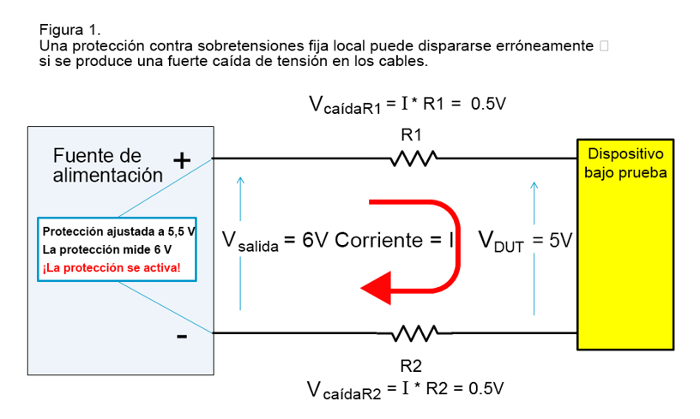 Fixed local surge protection (Figure 1): This is the most common type of protection. Imagine that the cables coming from the device under test are long, resulting in a significant voltage drop across them. If we want 5 V at the device under test, but there's a 1 V drop across the cables, the power supply will have to produce 6 V to deliver 5 V to the device. How do we then set the surge protection threshold? If we set the protection at 5.5 V, it might activate erroneously, as the local protection will detect 6 V when the device under test is only presenting 5 V. The solution in this case would be to set the surge protection at a higher level to prevent false tripping, although the protection will be less effective. Another solution would be to detect the surge remotely at the device under test (e.g., with a remote detection point) instead of detecting it locally at the power supply output.
'
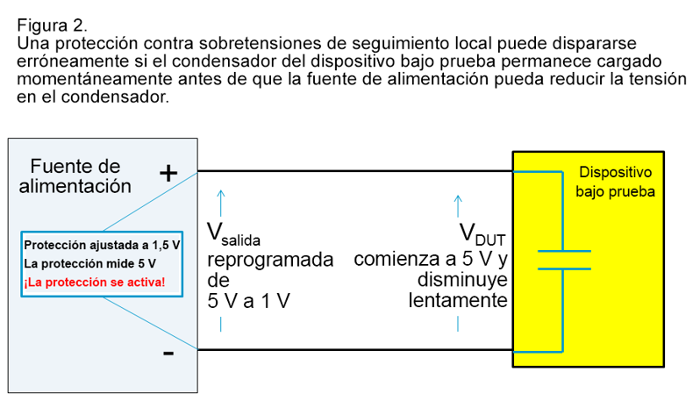 Local tracking overvoltage protection (Figure 2): Let's imagine we have a large capacitor in the device under test and we've set the local tracking protection to 0.5 V above the programmed voltage. We supply 5 V to the device under test, so the local tracking protection is set to 5.5 V. Now we want to reprogram the supply to 1 V, so we set the source to 1 V and the local tracking protection to 1.5 V. However, the capacitor in the device under test still has 5 V, as the capacitor voltage takes time to drop, even though the overvoltage protection circuit is still detecting more than 1.5 V and is tripping erroneously due to the momentary (and expected) overvoltage. The solution in this case would be to introduce some kind of delay to allow the capacitor to discharge, but this delay would leave the device unprotected for a while.
Remote monitoring surge protection (Figure 3): We have already seen that monitoring (with delay) protection deals with changing voltages during testing and, being remote, protects against cable losses. Thus, it would seem that remote monitoring (with delay) protection would have all the advantages, but to protect the device under test, we now depend on the detection lines functioning correctly. Is this a good idea?
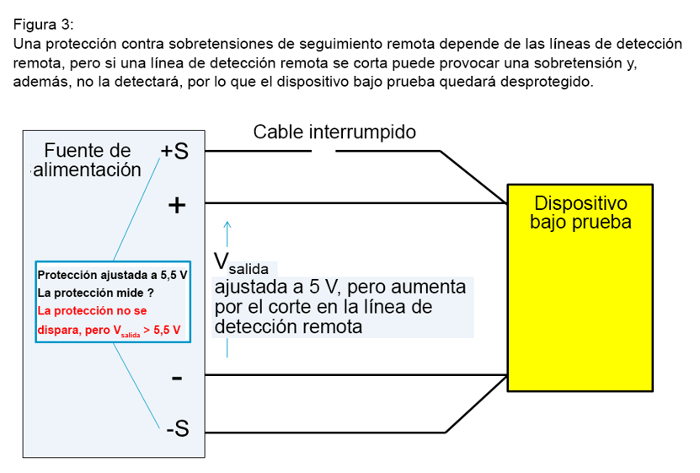 Remote sensing lines can be severed, a fairly common occurrence in test systems. Without sensing wires, the output voltage of a power supply typically rises (and there is no response via the sensing lines, as they are interrupted). This voltage increase causes an overvoltage condition. However, because the sensing lines are severed and the protection circuitry does not detect the overvoltage, the device under test does not trip. While remote-tracking surge protection appears to be the solution to false tripping, it may fail to detect a genuine overvoltage if the remote sensing lines are severed.
Summary
When protecting a device under test, a trade-off must be made between the highest level of protection and the possibility of false tripping of the surge protection circuit. Understanding how surge protection works and when it might cause a false trip or fail to detect a surge will allow us to determine the appropriate method for protecting the device under test, based on the characteristics of the test environment.