
While the vast majority of medical equipment requires conventional power supplies that are well-suited to their operating environment—essentially running a marathon by providing constant power day after day throughout their lifespan—certain application categories require a power supply capable of delivering power spikes, whether occasional or repetitive. For these applications, medical equipment manufacturers must consider a range of parameters to ensure that their selected power supply is capable not only of running a marathon but also, in certain specific applications, of performing a sprint without compromising safety, performance, and reliability.
What needs to be considered when a marathon demands sprint-level performance?
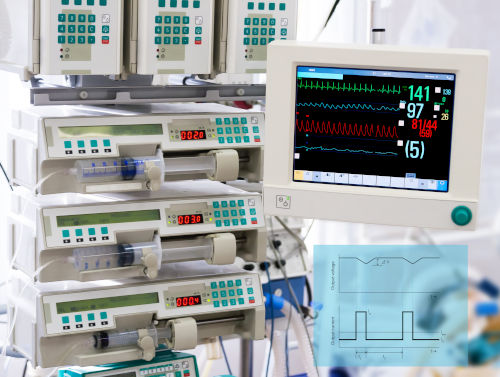
While it's obvious to medical equipment manufacturers that a power supply must comply with safety standards (EN/IEC 60601-1), its output performance depends heavily on the load behavior of the end equipment. Although power consumption in monitoring and supervision systems is relatively stable and easy to predict, in medical equipment such as hospital beds, infusion pumps, patient ventilators (including DC motors), and electromechanical switches that behave as inductive or capacitive loads, the power supply may need to deliver additional power for periods ranging from a few milliseconds to several seconds (Figure 1). While the duration of these power spikes may seem short compared to normal operating time, they must be carefully considered to avoid costly surprises.
Aside from voltage and output power, the type of load will determine what's important for the system designer to consider. There are many possibilities, and in some equipment, the main power supply might feed a variety of systems and subsystems with different load profiles, which is obviously more complex to address. To simplify, we could list four basic types of loads: inductive, capacitive, constant current, and nonlinear resistive. Each of these has specific behaviors that require attention when selecting a power supply for each application.
 Load Types, in Summary:
Inductive Loads: Loads such as motors and electromagnetic switches (e.g., relays, magnetic switches) with an inductive characteristic are called inductive loads. When a voltage is applied to a DC motor, a current several times greater than the nominal value will flow through the load; while when the voltage is cut off, due to the inductive component of the load, a back electromotive force (EMF) voltage E = -L × (di / dt) will be generated. Generally, when a voltage is applied to an inductive load, the power supply can maintain the energy required by the maximum demand only up to the limit of its overcurrent protection (OCP) function (Figure 02). If the limit is exceeded, even briefly, the power supply may shut down. This is why the maximum load must be well defined in order to select a suitable power supply with overcurrent protection that allows for a power increase for a defined time and sequence. Furthermore, when the output voltage is switched off, the back electromotive force generated (which is usually absorbed by the power supply's electrolytic capacitors) can trigger the power supply's overvoltage protection circuit, causing it to shut down. In this case, measures such as adding a reverse voltage protection diode should be taken.
Capacitive Load: A load with a capacitance component is called a capacitive load. Examples include capacitors inserted to reduce power supply ripple voltage and capacitors used to handle load spikes. For this type of load, a very large load current, ipeak = (V/R), where R is the series (parasitic) resistance, will flow when a voltage is applied, because there is no charge on the capacitor. Although the power supply can detect and control the output voltage, if a large capacitor (more than several tens of thousands of microfarads) is inserted on the output side, the control system may not be able to detect the situation, and the output voltage may become unstable. It is important for system designers to consider the total amount of capacitance installed in their equipment and verify the power supply's ability to deliver the peak power required to efficiently charge the load, which in some applications could be several farads.
Constant current load: A load in which the current remains constant, even though the load voltage varies, is called a constant current load; an example is LED lighting in operating rooms. It is important to consider the type of overcurrent protection incorporated in the power supply. If, for example, the power supply's overcurrent protection feature is of the current pull-down type, the output voltage may not be able to increase (Figure 02). This is because the output voltage stabilizes at the drop-off point of the power supply's overcurrent protection feature from the moment a voltage is applied until the nominal voltage is reached. Generally, changing the overcurrent protection feature to a maximum current limiting type can solve the problem.
Nonlinear resistive: Some equipment uses heating elements or lamps with filaments in which the resistance changes when current flows. Although this warm-up phase with a monotonic change in resistance may be short-lived, to the power supply it may appear as a constant current exceeding the threshold value of its built-in overcurrent protection.
Overcurrent protection, a crucial component of a power supply, has been mentioned in the preceding brief descriptions. It ensures that in the event of an overcurrent situation, which may occur accidentally or as a result of equipment failure, the power supply protects the equipment and, if necessary, signals the fault to the operator, for example, via an LED or a signal transmitted over the communication bus.
Overcurrent Protection Summary:
As explained previously, when the output current/power exceeds a defined limit, various types of damage can occur to the power supply or the powered equipment. In addition to preventing the current from exceeding the rated value, the protection circuit also limits the short-circuit current. Depending on the application and specific system requirements, several effects can occur when the OCP is activated: the output could be permanently disconnected with a manual reset, temporarily disconnected with an automatic reset, or behave as a constant, fixed-level, but safe current (Figure 02).
 When a power supply or electrical device is switched on, a high initial current flows to the load, starting from zero and rising to a peak value. The primary reason for this initial spike is to charge the large decoupling or buffer capacitors within the power supply and the end device. During this sequence, as the capacitors charge or the devices come up from a cold state, the current rises very rapidly from zero, reaching the peak current and then gradually decreasing to the steady-state current (Figure 3). During this period, the power supply must provide enough energy to charge the capacitors and deliver the necessary power to the load without triggering the overcurrent protection (OCP), which disconnects the output. Additionally, some loads may initially behave like a short circuit and require the power supply to avoid entering protection mode.
To accommodate this startup sequence, power supplies are designed to allow for a certain level of overcurrent, and it is common to set the overcurrent protection (OCP) threshold at around 110% of the maximum rated value.
110% is sufficient for the vast majority of applications, although for demanding medical equipment requiring peak power levels in the 200-300% range for a few seconds, 110% will not suffice, and a power supply designed not only to deliver high peak power but also to ensure maximum reliability throughout the equipment's lifespan is required.
Running a marathon at sprint performance levels!
A simple way to ensure the power supply delivers sufficient energy when extra power is required is to choose a power rating for the maximum power required during peak demand. For example, if the maximum constant power a device needs is 500 W and the peak is 1,000 W, taking into account operating conditions such as input voltage, ambient temperature, power reduction, etc., the system designer might consider a 1,200 W power supply as the most suitable solution.
This seems obvious but excessive when the peak only occurs occasionally. For example, when a DC motor is activated to position a patient's bed and then shuts down, and the power supply only powers the control system. It is also excessive for systems that require repetitive peak loads for a limited time compared to steady-state power.
 Choosing a power supply for peak load applications requires evaluating operating conditions throughout the equipment's lifespan and considering all aspects, including size, weight, and price. Purchasing a 1200W power supply when peak load represents only a limited portion of operation may not be the best option.
Power supply manufacturers have developed solutions capable of delivering considerable additional power—on the order of double the nominal power, or even more than the maximum—for a significant duration. To achieve this, the power supply must be designed to accommodate sufficient capacitors (Figure 4) and also have a power train capable of sustaining repetitive peak demands without overheating or negatively impacting reliability. As an example, we can examine the output voltage behavior of the COSEL 600W AEA600F series (Figure 5) when a maximum load is applied to the output. The tested product is a 600W rated power unit, delivering 24V at a rated current of 25A. As shown in Figure 6, the power train and output capacitors have been selected to sustain a peak power twice the rated power for a duration of 1000 milliseconds. Figure 6 depicts two conditions: no load at 52.5A peak, and half load from 12.25A to 52.5A peak. Under both conditions, the voltage remains within specified limits and the overcurrent protection (OCP) does not shut down the output.
 In conclusion
, achieving marathon-level performance in medical power supplies is a reality, and while the wide variety of applications requires different types of power supplies, technology is making it easier for system designers to choose the right products for their needs. This is all without mentioning the fantastic opportunities presented by new technologies such as broadband semiconductors, supercapacitors, and digital control, which are arriving in the next generation of power supplies and making the lives of power system designers very exciting.
------------------------------------ END ------------------------------------
Author: Patrick Le Fevre
References:
Powerbox (PRBX)