




 Meteorology, climate change monitoring, air traffic control, and wind power generation all rely on Lidar (Light Detection and Ranging) equipment—positioning and light detection—which, for example, detects cloud and aerosol layers, ash concentrations in the atmosphere, and wind gusts at airports and wind farms. Lidar equipment sends laser signals into the sky and counts the reflected photons. The laser wavelength depends on the temperature, which must be kept constant within +/- 0.1°C to ensure reliable operation. This has proven to be no easy task, as the equipment has to operate in extreme conditions ranging from -20°C to +55°C, in places like the Gobi Desert or Spitsbergen.
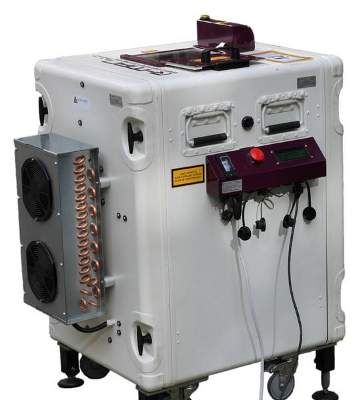
Several factors played a particularly important role in this project: very strict requirements to ensure compatibility with the existing LiDAR system, the highest demands in terms of thermal design, and a very limited temperature range. AMS Technologies was able to offer the best possible solutions for this range of specifications. The internal space was limited to a depth of 80 mm, which led AMS Technologies to design a very flat, split refrigeration unit integrated into the cabinet door. The internal side houses two mini-compressors, evaporator heat exchangers, fans, heaters, a control panel, an AC/DC converter, and other components of a vapor compression circuit. The external side of the door houses the condenser heat exchanger.
The 24VDC mini compressors are driven by a linear speed controller that not only ensures temperature stability of +/- 0.1°C, but also minimizes vibration, a key parameter in laser applications. Cooling capacity exceeds 600W at an ambient temperature of 55°C and an internal temperature of 35°C. Power consumption is less than 350W.




