




 Designers now have a wide range of thermal materials at their disposal, reflecting a shift in best design practices. This shift is replacing the ventilation of electronic components with the widespread use of heat sinks and establishing precise connections between hot components and dissipative surfaces, such as the metal chassis or case lid. This change demonstrates a general demand for miniaturized assemblies. The ever-increasing density of components effectively reduces the volume of air available for cooling and impedes its circulation. Where a fan was once used to cool the system with forced air, a fanless design is now often preferred to reduce costs, power consumption, size, and audible noise. Moreover, the fan is often the least reliable component in the system.
Air as an Enemy:
Static air is considered an enemy of thermal management. With its low thermal conductivity of only 0.024 W/mK, compared to 250 W/mK for aluminum, air trapped in microscopic pockets at the interface between a heatsink and a component can severely impair heat transfer. Traditionally, thermal grease or a phase-change material was applied to the surfaces to eliminate these air pockets.
To meet modern thermal management practices, a wider variety of products and materials with broader properties are now available, helping engineers effectively eliminate air gaps throughout the case. A major challenge designers face today is filling relatively large air gaps within the case. These can range from 1 mm to 5 mm in size. Furthermore, where multiple components are mounted on a common heatsink, the size of the air gaps can be inconsistent and vary from component to component. This problem can be further compounded by the accumulation of mechanical assembly tolerances. In these cases, the chosen filler must be able to compensate for such variations to maintain firm contact with each surface without exerting excessive forces on the component case.
Thermal pads and gels are two of the most popular thermal solutions used today. Pads, which are compressible elements with a silicone elastomer binder filled with thermally conductive particles, conform to the contours of your motherboard. Gel is a vulcanized silicone material that can be applied with a pump or dispenser. It is ideal when the distance between the component surface and the adjacent cold surface may vary, for example, when multiple components are connected to a common heatsink. It can also be used as an alternative to traditional thermal grease or phase-change material because it exerts only a low and consistent force on the board and its components.
 Filler Pads:
Advances in polymer-based bonding materials capable of operating over a wide temperature range have been essential in the development of filler pads, as they solve many of the current thermal management problems faced by engineers. Commonly used silicone elastomers have a low compression modulus, allowing them to conform to the contours of bonding surfaces with minimal compression. This avoids high forces on components and solder joints. Therefore, a low compression modulus and high thermal conductivity are ideal qualities for a filler pad. New materials, such as Chomerics' HCS10, reveal a persistent trend toward increasingly softer compounds, which are clearly very useful when designing delicate electronic systems with a small form factor.
Many different levels of thermal performance are offered, with thermal conductivity ranging from less than 1 W/mK to more than 6 W/mK. Since conductivity is usually determined by the amount and type of conductive filler, which can be particles of a ceramic material or a metallic compound such as aluminum oxide, zinc oxide, or boron nitride, higher conductivity is typically achieved by increasing the compressive modulus.
Designers can also choose from various compression modulus values. Among the most compliant formulations are the THERM-A-GAP™ HCS10 pad, a material that deflects 73% at 50 psi, and the THERM-A-GAP 580, which deflects only 30% under the same conditions. Consequently, some fillers can be used to dampen vibrations while also offering conformability properties for thermal management.
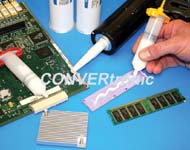 Filler pads are typically available in various thicknesses. However, designers must keep in mind that the thermal conductivity of a pad is much lower than that of metal. A pad is not a solution for poor thermal design, so engineers should aim to make gaps as small as possible so they can be filled with minimal-thickness filler pads.
Thermally conductive pads can be ordered as full sheets, cut to size, or as custom-cut pads on a sheet or as individual components. A backing, such as aluminum foil or fiberglass, is also applied. The pad surfaces typically have some degree of tack to hold them in place and minimize contact resistance. A pressure-sensitive adhesive may be pre-applied to a surface to establish permanent contact with the cold material. Low-outgassing and silicone-free formulations are available for silicone-sensitive applications such as aerospace and optical electronics equipment and disk drives.
Thermal gels
, on the other hand, can be supplied as a bulk material or in cartridges or syringes. Under normal conditions, it can be stored without refrigeration, and the gel does not tend to harden.
Thermal gel offers several important advantages, including eliminating the need to maintain a supply and inventory of filler pads in multiple shapes and sizes, and ensuring the accuracy of pad selection and placement. The gels dry completely and retain their shape, making them easy to use in production environments. They can be applied in-line with high repeatability in shape and volume using automated dispensers. In some cases, a round application optimally covers bonding surfaces, while serpentine, box, or spiral shapes are frequently used to reach the ends of integrated circuit packages such as QFN, LGA, or BGA. A single line of gel is undoubtedly best suited for securing a heatsink to a traditional DIL package.
A wide variety of thermal gels are available, such as Parker Chomerics' GEL30, which is suitable for both filler applications and as a direct replacement for thermal grease. In comparison with these, the cross-linked structure of the gels guarantees a low modulus and eliminates drawbacks such as emptying and drying.
 The GEL30 offers a thermal conductivity of 3.5 W/mK. Compared to some filler pads, gels place a much lower mechanical load on components. This is often important, given that the latest product designs tend to use quick-release, click-fit assemblies, whose clamping forces can never be as high as those of traditional screw-type assemblies, which are more time-consuming and exert greater compressive force on the interface material.
Gels capable of maintaining electrical isolation between the component and the heatsink are also available. These gels incorporate glass microspheres, 0.25 mm in diameter, which act as a dielectric or compression stop, ensuring a minimal gap between the component surface and the heatsink. This allows engineers to leverage the gel's properties when using power packages where the thermal connection also provides electrical termination to the chip.
Summary:
As part of a well-conceived thermal management strategy, thermal pads and gels can fill most of the air spaces that cannot be eliminated during the design process of electronic equipment. Both types of fill incorporate advanced technology materials and offer numerous advantages in terms of performance and ease of use. Each is a very useful tool for engineers aiming to maximize the thermal performance of a new design.
Author:
Riaz Ahmed, Chomerics Division Europe -
Parker Hannifin Ltd




