




Main cooling techniques for power supplies:
There are three main techniques for cooling power supplies: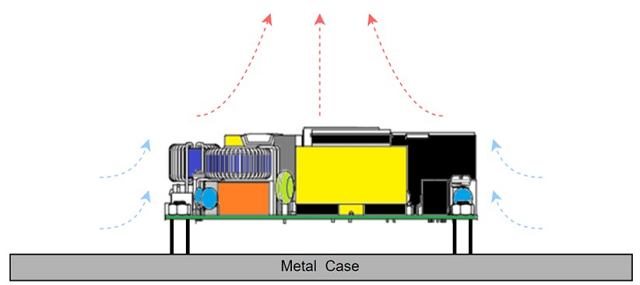
1. Natural convection:
When a power source is heated, the surrounding fluid (such as air) near the heated surface heats up and becomes less dense, causing it to rise. As it rises, cooler fluid from the surroundings replaces it, creating a natural circulation pattern.

2. Forced-air cooling:
This is a heat transfer method that relies on the use of mechanical devices, such as fans, to enhance the natural convection process and increase the heat dissipation rate of a power supply.

3. Conduction cooling:
This is a heat transfer method that occurs through direct physical contact between two objects at different temperatures. The heat generated by the components is transferred from the hotter object to the colder object (metal case) through molecular interactions, without the involvement of fluid movement.
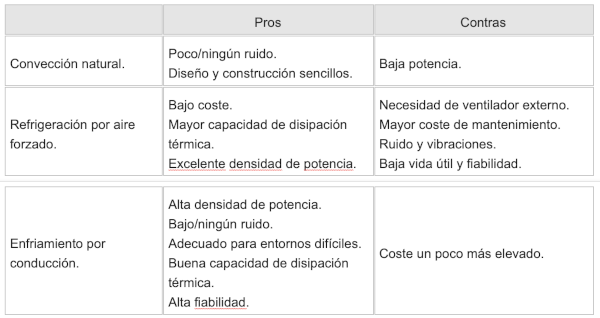
The table above shows that conduction cooling would be the most cost-effective and reliable solution, making it ideal for use in harsh environments.
How can a fanless power supply be designed?
Traditionally, industrial power supplies dissipate heat to built-in heatsinks or a U-channel chassis. The basic structure is shown below as Fig. 1. However, most of the heat remains in the power supply or the system, which can significantly impact overall system reliability and over-temperature protection.

Fig. 1 Conventional open-frame power supply structure design.
The solution to this problem is to efficiently transfer the heat source to the outside of the system. The heat generated by the power supply comes mainly from critical components such as power devices, magnets, and capacitors. If these components are mounted directly onto a metal base (motherboard) and secured to the metal system case, the heat can be successfully transferred to the outside. Fig. 2 below shows one example and how the concept works.
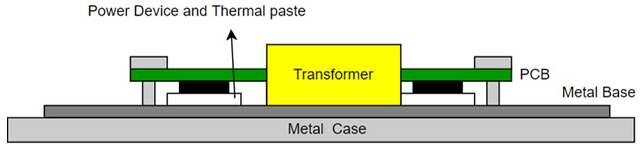
Fig. 2 Motherboard-cooled power supply structure design.
The CFM500S series offers a similar motherboard cooling method, and users can add an additional metal plate measuring 480 mm * 248 mm * 1.2 mm beneath the CFM500S motherboard to improve heat dissipation performance. As shown in the installation photos below, for further details, please consult our experts at Media MicroComputer.

When used with the motherboard's cooling solution, the CFM500S series can deliver 500W (full load) without a fan. The power reduction curve is as follows:
Cincon Solutions:
Cincon's fanless AC-DC power supply solutions, including open-frame, shroud, and brick types, are suitable for a wide variety of systems. The wattage range spans from 70W to 750W. The motherboard cooling design allows all series in the fanless category to achieve higher power density and improved heat dissipation performance in fanless conditions and at higher ambient temperatures. If you are looking for a power supply with all the aforementioned features, a Cincon fanless power supply would be your ideal choice.
You can view the full product portfolio of this leading power supply brand, Cincon, through Media MicroComputer 
Source of the article: Cincon Electronics Co.




