




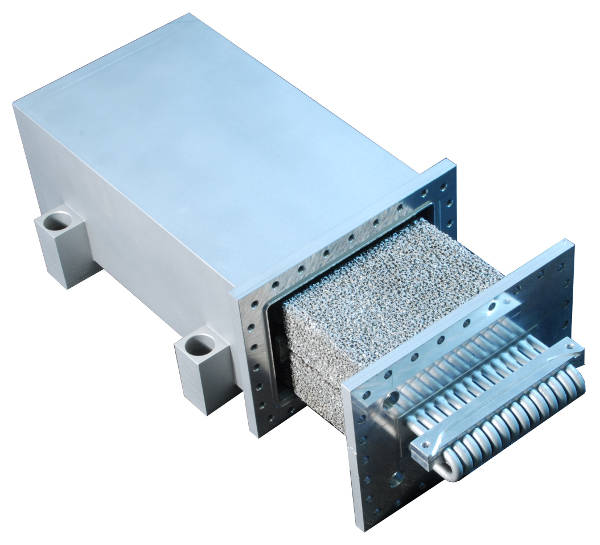
REXUS consists of a curved aluminum tube wrapped in metallic foam and partially inserted into a metal box containing paraffin wax that fills the pores of the foam material. Due to the heat, the fluid circulating inside the tube changes phase to a gaseous state. The vapor carries the heat to the area where the metallic foam is located, causing the paraffin wax to melt and the fluid to condense. Tests were conducted by installing the device on the REXUS 22 rocket, which followed a parabolic trajectory to a maximum altitude of 90 km.
The second prototype designed and manufactured by Aavid for the INWIP project is the ISS: a pulsating heatpipe system connected to eight Peltier cells. Heat is transported as a gas into the aluminum tube, heating one side of the Peltier cells, while the other side is cooled by a liquid cooling plate (LCP). The prototype will be deployed on a zero-gravity flight, during which an aircraft will travel through 32 parabolas. At the peak of each parabola, the gravitational force will be balanced by vertical thrust, creating a 22-second transient state of microgravity. During this time, the behavior of the pulsating heatpipe will be observed.
Another objective of the research is to prepare systematic experiments on Thermal Platform 1 (TP1) aboard the International Space Station, in order to investigate the performance of cooling systems using conventional and innovative fluids.




