


Highlights include a new type of Teflon™ PTFE extrusion paste for high-speed processing, Teflon™ fluoropolymer foam (FFR) resins produced using physical foam technology, enabling cable miniaturization and weight reduction, and a high-performance Teflon™ FEP (fluorinated ethylene propylene) resin for high-speed data transmission cables. Furthermore, in collaboration with Prettl Automotive of Pfullingen, Germany, the company is presenting innovative cable and sensor solutions tailored to the challenges of modern road transport, such as zero emissions, electric mobility, and autonomous driving.
The increasing complexity of the automotive sector, driven by the latest developments in autonomous driving and new electric drive technologies, as well as the greater role of electronics in vehicles, demands a new level of reliability and safety in products and components. Cable assemblies not only have to withstand harsh environments but also need to be robust in confined assembly spaces. Chemours' Teflon™ fluoropolymer resins can help achieve these objectives due to their combination of high dielectric strength, outstanding chemical resistance, inherent flame retardancy, and good processability. At its booth at Wire, the company will showcase key solutions developed by its partner Prettl for automotive subsystems, such as sensors for exhaust gas treatment, as well as for oxygen and temperature management.
One product solution that stands out is Teflon™ fluoroplastic foam resin (FFR), based on a patented Chemours technology. The demand for miniaturization, increasing data transmission rates, and unprecedented high-frequency data transmission require innovative materials and technologies. Cables made with fluoroplastic foam insulation have lower return signal loss than conventional data cables, enabling miniaturization and weight reduction thanks to their lower density and thinner insulation.
Martin Brück, Market Development Manager Transportation at Chemours, comments: “The evolution of automotive technologies is accelerating at levels unprecedented in its 130-year history. At Chemours, we are committed to supporting our customers across the entire value chain, developing materials and solutions that help address the challenges of electric mobility and make smart cities even smarter.”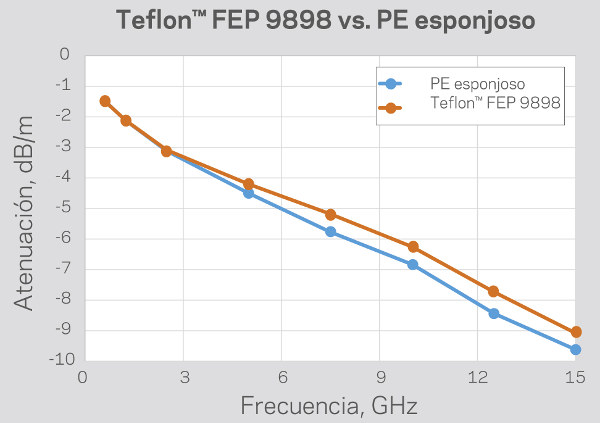 Another product to highlight is Teflon™ FEP 9898 (Fluorinated Ethylene Propylene). Recent tests conducted by an independent laboratory have demonstrated that data cable insulation made with this high-performance fluoropolymer resin can enhance transmission performance by reducing attenuation and insertion loss compared to conventional sponge polyethylene (PE) insulation.
In fine powder technologies, the new Teflon™ PTFE 641XT X paste extrusion resin has been specially developed for optimized processing and performance. It is aimed at the growing market for cost-effective cable insulation production. It allows for longer extrusion lengths due to a significantly reduced ratio, greater flexibility in extrusion designs and dimensions (e.g., channel extrusion based on the Chemours patent), a wider processing window, reduced cable insulation thickness, and lower lubrication requirements.
In response to the industry's ongoing challenge of providing high-temperature perfluoroplastics capable of melt processing up to 300°C (per UL 746B), Chemours offers the ECCtreme™ ECA family, which combines the advantageous mechanical, electrical, and chemical properties of PTFE with high thermal stability.
To complement this portfolio for the wire and cable industry, Chemours offers the Viton™ FreeFlow™ family of extrusion process aids. These benefits include lower dosage requirements and higher throughput, and can contribute to improved productivity and cost savings.