




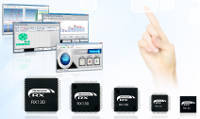
The new group allows embedded system developers to incorporate both the user interface (i.e., the touch key) and system control capabilities into a single MCU. Developers work with touch-based capacitive applications that can leverage Renesas' capacitive touch technology, with its own and mutual capacitance, ultra-low power consumption, in a low-cost, low-power 32-bit MCU.
The new RX130 Group combines excellent sensitivity and noise tolerance, making it possible to develop tactile keys using various cover materials, including acrylic, glass, wood, fabric, or stone, for use in a wide range of new applications. These include control panels for electrical appliances used in potentially wet locations, household equipment using flush-mounted switches for a more aesthetically pleasing design, and industrial machinery that must be operated with gloves for safety reasons.
The new RX130 group complements Renesas' existing range of MCUs supporting capacitive touch applications, including the RX231 group for high-end home appliances and industrial machinery, supporting DSP/FPU (Note 2) and enhanced security and communication functions; and the RX113 group for home and healthcare equipment, devices with LCD display functions and USB communication. With the addition of the new RX130 group, the Renesas MCU range for touch applications comprises 256 product versions in total, with flash memory capacities ranging from 64 KB to 512 KB and pin counts ranging from 48 to 100 pins. Pin and software compatibility are maintained between the RX231 and RX130, making it possible to reuse existing software resources and providing coverage for devices from the mid-range to the high-end.
The main features of the RX130 Group:
The RX130 MCU can support complex user interface requirements with support for up to 36 touch keys in self-capacitance mode and up to 36 keys via matrix configuration. The RX130 Group also offers mutual capacitance mode, allowing the number of touch keys to be expanded. This reduces wiring complexity when adding a touchpad and helps simplify board design. The high-speed 32-bit CPU process means the CPU load is less than 10 percent, even when controlling 64 keys. The RX130 Group allows developers to run processor-intensive applications while managing the capacitive touch interface.
The use of an on-chip oscillator operating at 15 kHz (kilohertz), a low-power timer that consumes very little energy, wakes the CPU from sleep at regular intervals to detect contact with the touchpad. This allows the RX130 group to achieve an industry-leading low standby current of approximately 8 μA (Note 1). The low standby current helps reduce the power consumption imposed by adding a touch key, enabling capacitive touch capabilities for battery-powered handhelds and other devices with low-power requirements.
Using the Workbench6 automatic calibration tool with Renesas MCUs for touch keys makes it possible to use a graphical user interface (GUI) to easily adjust sensitivity and other options, something previously complicated by factors such as board design and tracking pattern, panel material, etc. Future updates to Workbench6 will allow it to be used not only as a development tool but also in conjunction with the software and development information that is also being made available, including application notes, user manuals, and reference software. It will be possible to use Workbench6 with a sample MCU and evaluation board to immediately confirm and evaluate system performance. An evaluation kit based on the RX130 touch key, which includes Workbench6, is scheduled to be available in February 2016.
Availability:
Samples of the RX130 Group are now available. Mass production is scheduled to begin in March 2016 and reach a scale of 500,000 units per month by March 2017.
Note 1) Standby current for a touch panel channel with a period of 100 ms.
Note 2) Digital signal processor / floating point unit
Note 3) An integrated development environment that supports the Renesas RX MCU family (RX600, RX200 and RX100) that is based on Eclipse, a widely used open-source integrated development environment, and CDT plugins that allow the use of the C/C++ language for development.





