





Compared to similar low-power MCU products in the industry, it has richer and more flexible peripheral resources for different applications, paving the way for continuous optimization of system-level power consumption. The new series can be widely used in typical markets ranging from industrial meters and small consumer electronics devices to portable medical equipment, battery management systems, and data acquisition and transmission, among others. The GD32L233 series is available in 10 part numbers supporting QFN32, LQFP32, LQFP48, and LQFP64 package options.
The ultra-low power concept permeates the entire chip design process at multiple levels, including the evolution of manufacturing processes, the development of design concepts, and chip architecture innovation. The new GD32L233 series of low-power MCU products can effectively optimize system power consumption by:
- Manufactured using an ultra-low power process. The GD32L233 series adopts 40nm ultra-low-power (ULP) manufacturing technology with low leakage currents, reducing power consumption at the hardware level.
It features specially optimized low-power analog peripheral interfaces (IPs). Energy-saving products often operate in a static standby mode, which can be activated at any time to determine which part of the chip's analog and peripheral circuitry is active. The GD32L233 series integrates specially optimized low-power analog IPs to effectively reduce power consumption.
It also adopts a very low-power digital design methodology. The new chip follows a variety of low-power digital design concepts, including multi-voltage domain design. In various operating modes, the chip can control the on/off states of resources to avoid unnecessary power loss, further improving its low power efficiency.
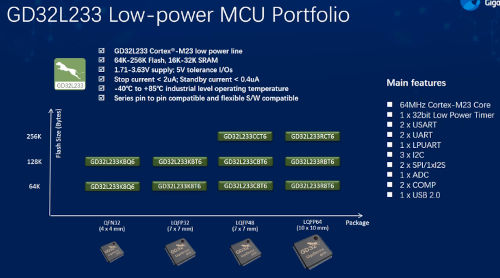 The GD32L233 series MCU supports a system frequency of up to 64 MHz, integrated eFlash from 64 KB to 256 KB, SRAM from 16 KB to 32 KB, and various enhanced peripheral and I/O resources connected to two APB buses. The series continues to utilize the industry-leading Arm® Cortex®-M23 core and delivers high-efficiency processing capabilities through the reduced yet powerful Armv8-M instruction set. The fully optimized bus design, which supports independent multipliers and dividers, contributes to very low power consumption and high-efficiency energy savings in embedded applications.
The GD32L233 series achieves excellent power efficiency. Deep sleep current is reduced to 2 µA, wake-up time is less than 10 µs, and standby current is a very low 0.4 µA. Several system clocks can trigger deep sleep mode, and peripheral interfaces support multiple wake-up sources, including a low-power timer, low-power UART, RTC, LCD, standard I2C, USART, etc. The MCU operates from 1.7V to 3.6V and supports a battery power supply (Vbat). The newly designed power management unit provides up to six low-power modes, including partial sleep, deep sleep, and external wake-up. Under maximum frequency and full-speed active mode, power consumption is only 66µA/MHz, demonstrating excellent energy efficiency. Flexible power delivery modes can achieve lower average power consumption and extend battery life.
More innovative solutions are provided by enriched peripheral interfaces.
The new MCU is equipped with a large number of peripheral interfaces to improve connectivity and GPIO multiplexing rate. Compared to equivalent ultra-low-power MCUs on the market, the GD32L233 series offers more I/O resources in the same package. Excluding the power supply, the remaining I/O interfaces can be used to configure more functions, significantly improving usability.
The GD32L233 series provides up to four general-purpose 16-bit timers, two basic timers, and one 32-bit low-power timer. Standard and advanced communication interfaces are also supported: up to two USARTs, two UARTs, one low-power LPUART, three I2C ports, two SPI ports, one I2S port, and one USB 2.0 FS controller. Furthermore, the 32-bit low-power timer and the low-power UART can operate in partial deep sleep mode and wake the MCU. For analog peripherals, it integrates a 12-bit ADC with a sampling rate of up to 1 MSPS, a 12-bit DAC, and two comparators.
The GD32L233 MCU features a new multi-channel DMA selector module (DMAMUX), which increases routing flexibility between peripherals and DMA. Through self-configuration, DMA functionality can be provided for almost any peripheral. The MCU integrates a full-featured calendar RTC, a programmable voltage detector (PVD), and a programmable voltage drop reset (BOR), which can monitor battery power and voltage anomalies and then activate the MCU. It also supports an LCD segment controller, providing 8x28 segments and 4x32 segments in two formats. Additionally, it integrates a high-precision temperature sensor with an accuracy of ±0.5°C, making it particularly suitable for developing wearable personal health monitoring equipment, such as blood pressure/oxygen monitors, and environmental control sensors.
Samples and development boards are available from November 2021.
- GD32L233R-EVAL full-featured evaluation board.
- GD32L233C-START and GD32L233K-START entry-level learning boards.





