

This MCU series is also suitable for budget-constrained scenarios, making it an ideal choice for office equipment, payment terminals, and various IoT products.
The GD32VW553 series MCU incorporates a new open-source instruction set architecture with a RISC-V processor core and a maximum clock speed of 160 MHz. It also features advanced hardware DSP acceleration, a double-precision floating-point unit (FPU), instruction expansion interfaces, and other resources. Through its microarchitectural design, this combination results in exceptional energy efficiency while providing flexibility for scalability.
The integrated 2.4 GHz Wi-Fi 6 RF module adheres to the IEEE 802.11ax standard and is backward compatible with IEEE 802.11b/g/n, ensuring its suitability for various network environments. It supports Orthogonal Frequency Division Multiple Access (OFDMA), enabling multiple devices to share channel resources, resulting in up to 60% faster data transmission speeds compared to Wi-Fi 4. Furthermore, it offers support for Multiple Users, Multiple Inputs, Multiple Outputs (MU-MIMO), allowing multiple devices to operate simultaneously without interference.
The integrated Bluetooth LE 5.2 RF module extends communication range, boosts performance, enhances security, and conserves power by adhering to the latest Bluetooth specifications. It provides a high-speed data mode of 2 Mbps and multiple speeds of 125Kbps/500Kbps to reduce transmission time and improve sensitivity. It facilitates the establishment and configuration of stable, high-speed wireless networks, even with multiple devices and complex environments.
The combined wireless MCU offers advanced baseband and RF performance with a variety of additional features. It supports the wireless coexistence protocol based on the Packet Traffic Arbitration (PTA) mechanism, which reduces interference on the same frequency caused by Wi-Fi and Bluetooth, thus improving signal reception stability. Furthermore, it is equipped with automatic gain control (AGC) across a high dynamic range to enhance signal quality. Thanks to Wi-Fi 6's Target Wake Time (TWT), the GD32VW553 can flexibly schedule sleep and wake times, improving efficiency and meeting the access requirements of wireless devices with low power consumption and long battery life.
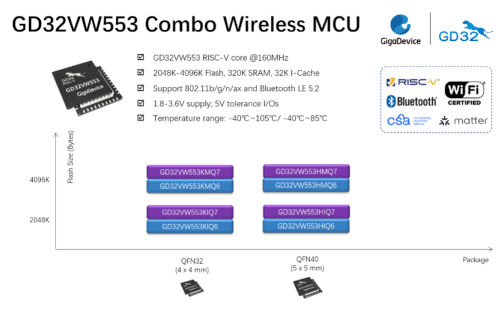
This new GD32VW553 series integrates up to 4 MB of Flash, 320 KB of SRAM, and 32 KB of configurable instruction cache (I-Cache) to greatly improve CPU processing efficiency. Offering excellent wireless performance, the GD32VW553 is also equipped with universal wired interfaces, including three U(S)ARTs, two I2Cs, one SPI, one four-wire QSPI, and up to 29 programmable GPIO pins. Its integrated components include two 32-bit general-purpose timers, two 16-bit general-purpose timers, four 16-bit basic timers, one advanced PWM timer, and a 12-bit ADC. The power supply voltage ranges from 1.8 V to 3.6 V, and it offers high operating temperatures up to 105 ℃ to meet the needs of applications such as industrial control interconnects, lighting equipment, and power strips.

The GD32VW553 series supports Wi-Fi Protected Access (WPA) security, incorporating the latest WPA3 encryption technology for both personal and corporate networks. The hardware encryption and decryption engine supports DES, Triple DES, AES, and Hash algorithms. It also supports the Public Key Cryptographic Acceleration Unit (PKCAU) to ensure data confidentiality and integrity during wireless communication. The True Random Number Generator (TRNG) can provide unpredictable data for key generation across a variety of security protocols, further enhancing the system's security capabilities.
The RISC-V development ecosystem for GD32 is highly compatible with existing MCU development environments and user habits, enabling them to create competitive, market-driven solutions. GigaDevice provides the GD32VW553 series MCU with a range of free development tools, including the GD32 IDE, the GD-LINK debugging and programming tool, and the GD32 all-in-one programmer. GigaDevice has also released SDKs containing the underlying driver, wireless protocol stack, and application routine. Development boards are available that support various real-time operating systems (RTOS) with local connectivity, cloud connectivity, security, and over-the-air (OTA) updates, allowing for rapid deployment of connected devices.
SEGGER has partnered with GigaDevice to offer developers free access to the SEGGER Embedded Studio IDE and a comprehensive suite of development tools. Sweden's IAR will also provide comprehensive support for the new GD32VW553 series MCU, including development and compilation tools, as well as tracing and debugging tools.
The GD32VW553 series MCU has received official Wi-Fi 6 certification from the Wi-Fi Alliance (WFA), Bluetooth certification from the Bluetooth Special Interest Group (Bluetooth SIG), and FCC/CE RF compliance certification. It complies with the Matter over Wi-Fi application standard developed by the international organization Connectivity Standards Alliance (CSA). This enables the GD32VW553 to facilitate seamless interconnections between various Matter devices, improving overall compatibility and interoperability of smart home systems.
This new product line offers eight different models in two compact packaging options: QFN40 and QFN32, with two industrial temperature ranges from -40°C to 85°C and from -40°C to 105°C. Samples and evaluation plates are available.