

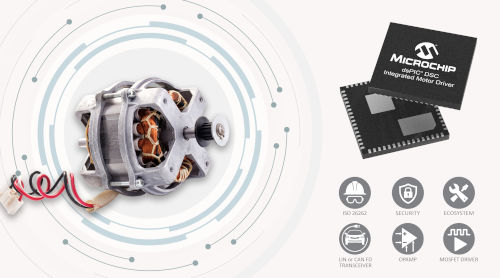
A key advantage of this integration is the reduction in the number of components, printed circuit board dimensions, and overall complexity of a motor control system design. The devices are supported by development boards, reference designs, application notes, and Microchip's FOC (Field Oriented Control) software development package, motorBench® Development Suite V2.45.
“Automotive, consumer, and industrial designs are evolving to demand higher performance in a smaller footprint. To meet these expectations, it’s often necessary to increase costs and volume,” said Joe Thomsen, vice president of Microchip’s Digital Signal Controllers business unit. “By integrating multiple device functions onto a single chip, dsPIC-based, DSC-based embedded motor drivers can lower system costs and reduce board footprint.”.
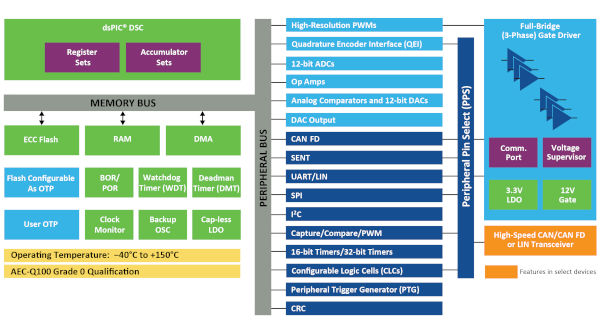
These integrated motor drivers can be powered by a single power supply up to 29V (operating) and 40V (transient). An internal 3.3V LDO (Low Dropout) voltage regulator powers the dsPIC DSC, eliminating the need for an external LDO. Operating between 70 and 100 MHz, these DSC-based integrated motor drivers provide high CPU performance and enable the efficient implementation of FOC and other advanced motor control algorithms.
For more information on Microchip's wide range of embedded motor drivers, visit the DSC-based dsPIC embedded motor drivers website.
Development Tools
A long list of software and hardware development tools for motor control helps to streamline and facilitate design, thus shortening the time to market for the customer.
The MSCK (Motor Control Starter Kit) dsPIC33CK and MCLV-48V-300W are two new development boards for dsPIC33-based embedded motor drivers that streamline prototyping with flexible control options. The MSCK includes a dsPIC33CK low-voltage motor control development board, a 24V three-phase BLDC motor, and an AC/DC adapter, along with a USB cable and other accessories. This cost-effective kit accelerates prototyping in motor control applications and operates between 12 and 48VDC with a continuous current of up to 10A. The MCLV-48V-300W development board enables rapid prototyping of three-phase permanent magnet synchronous motors between 12 and 48VDC and is capable of supplying up to 25A RMS of continuous current per phase. This inverter board introduces a new modular concept in which a DIM (Dual-in-Line Module) has been inserted into the board in order to configure it for a specific DSC dsPIC or microcontroller.
motorBench Development Suite is a free, graphical user interface (GUI) software development tool for FOC that accurately measures key motor parameters, automatically adjusts feedback control gains, and generates source code using the Motor Control Application Framework (MCAF). The latest version, v2.45, includes a powerful new feature called Zero-Speed/Maximum Torque (ZS/MT), which eliminates the need for Hall effect or magnetic sensors in applications and allows for achieving maximum motor output torque from start-up to low speeds. This feature can be used in pumps, power tools, electromobility, and many other applications.
MPLAB® Discover now includes many dsPIC-based MATLAB® Simulink® models that support various motor control algorithms and development boards. Microchip also provides free device blocks for Simulink that can be used to generate optimized code from models for DSC dsPIC and other Microchip microcontrollers.
Among the growing number of motor control reference designs are now an automotive cooling fan, a low-voltage ceiling fan, and a drone propeller controller.
These reference designs shorten time to market by providing a production-ready solution for various motor control applications. The board design files typically include schematics and a bill of materials, along with a user guide and motor control source code, all available for download.