




CIPs give developers the ability to perform tasks in hardware, freeing the CPU from other tasks or allowing it to enter sleep mode. This results in reduced power consumption, deterministic response times, and shorter firmware development and validation times. The PIC18F “K40” family of devices incorporates ADC2 (ADC with Computation), an intelligent A/D converter that, independent of the core, can control the data acquisition and signal analysis functions required in sensor interface applications, such as capacitive touch sensing.
The addition of CIPs to the PIC18F “K40” family builds upon the successful PIC18F “K20” family. These new devices are cost-effective and offer up to 128 KB of Flash memory, 5V operation, EEPROM, and numerous integrated peripherals. These peripherals include various core-independent peripherals for safety-critical applications (CRC/memory sweep, supervisor window timer, and hardware timer limiter), up to seven hardware PWMs, and multiple communication interfaces. The PIC18 “K40” family also offers intelligent analog peripherals such as a zero-cross detection (ZCD), an integrated comparator, and ADC2. The ADC2 handles signal analysis functions such as averaging, filtering, oversampling, and automatic threshold comparison, independent of the CPU.
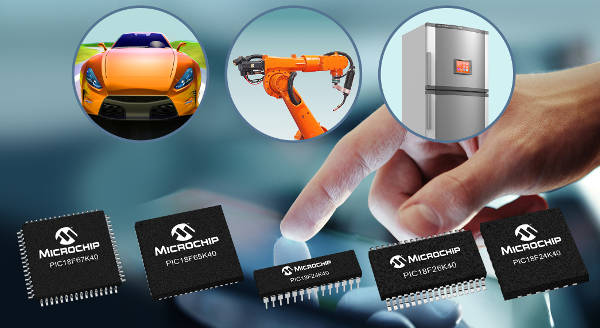
The device is well-suited for a wide variety of applications and market segments, such as touch detection, industrial control, consumer electronics, automotive, and the Internet of Things (IoT).
 The new PIC18F “K40” family is supported by the Curiosity High Pin Count (HPC) board and Microchip’s well-known software development platforms, such as MPLAB® Code Configurator (MCC), MPLAB IDE, the XC8 compiler, and the new cloud-based MPLAB Xpress IDE.
The family is currently in volume production and consists of 10 new models with 16-128 KB of Flash memory. They are supplied in 28-64 pin packages of the following types: UQFN (4x4x0.5mm), QFN, SOIC, SSOP, TQFP, and DIP.





