Since operating currents are significantly higher than a capacitor's leakage current, the operation of a circuit is not affected by DCL. However, if the application is battery-powered, such as consumer devices, mobile phones, MP3/MP4 players, DVD players, or automotive applications where capacitors are used in a battery-powered transmitter, the capacitor's leakage current will directly affect standby time, as it draws power directly from the battery.
In portable battery-powered equipment, general-purpose capacitors are typically used with 3.7V rechargeable lithium-ion batteries for several functions: backing up data and settings when the battery is being replaced or the charger is disconnected; smoothing voltage and current spikes the instant the battery is inserted and when the charger is plugged in/unplugged; and supporting the battery with stored energy when a higher current is required.

In automotive applications, tire pressure management systems wirelessly transmit pressure and temperature data from wheel sensors to a central control unit, which provides information alerts and warnings to the driver. A bulk capacitor is used in conjunction with the sensor, which must emit a pulse of energy when the measurement or transmission sequence is initiated, especially at very low ambient temperatures. A 3V lithium coin cell battery is often used for tire pressure warning systems due to its exceptional lifespan of over ten years. Lithium batteries also function well at low temperatures; however, under such conditions, they have higher internal resistance, resulting in a greater voltage drop.
Capacitor Requirements:
The nominal electrical resistance required for battery circuits is typically in the range of 22 to 220 µF, and a small, low-profile size is a common requirement to match the small size of the final device. Excellent performance at low and very low temperatures is obviously needed to ensure reliable operation. Therefore, tantalum and niobium oxide capacitors are the best choice. Standby power consumption must be minimized to maximize maximum lifespan. Both active and passive functions must be considered, and—as mentioned earlier—bulk capacitor leakage current is a mechanism that directly drains a battery, so reducing leakage current is important. The correct selection of a tantalum or niobium oxide capacitor is imperative if leakage current is to be minimized. Different formulas exist for the different AVX capacitor series to determine the basic leakage current (specified at full rated voltage and ambient temperature, 20°C).
Professional Trj series tantalum capacitors have a lower DCL under the same conditions as standard Taj products. Noj Oxicap® niobium oxide devices have a higher DCL. However, ambient temperature and voltage derating, as shown in Figures 1 and 2, are very important factors to consider when calculating DCL. TAJ series tantalum capacitors with the *LE suffix have been developed to further reduce the DCL values shown in Equation 1; voltage derating is a way to further reduce leakage current.
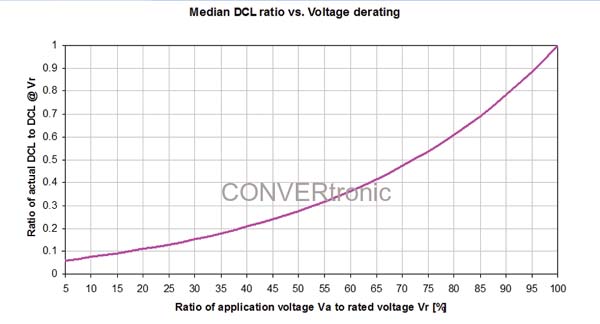
The typical DCL range versus rated voltage can be seen in Figure 2. This relationship can be approximated linearly by the inverse decimal logarithmic function with offset – see Figure 3.
Optimal voltage derating for minimum DCL
To achieve the optimal leakage current ratios for the application (DCLa) at room temperature, we must consider two factors: the basic DCL defined at the nominal voltage Vr as in equations 1; and the DCL ratio versus the voltage derating, see Figure 3.

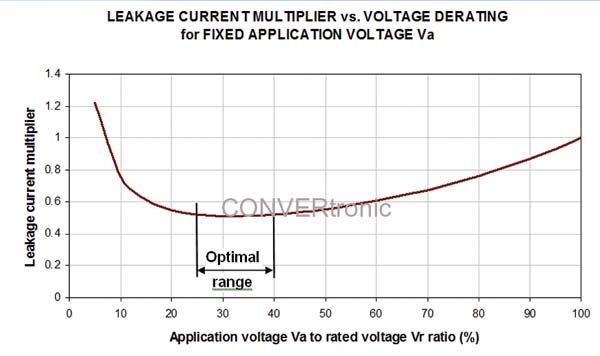
The maximum DCL multiplier versus Va/Vr for a fixed voltage application Va, see figure 4.
The maximum actual DCL value varies with different input conditions (selected capacitor series, rated capacitance, rated voltage), however, the shape of the graph (Fig. 4) will be the same. Therefore, we can identify the range of Va/Vr (derating) values with the minimum actual DCL as the 'optimal' range. Thus, the minimum DCL is obtained when the capacitor is used at 25-40% of its rated voltage – when the capacitor's rated voltage is 2.5 to 4 times greater than the actual application voltage.
Comparison of Capacitor DCL Performance in a Typical Battery Circuit Application.
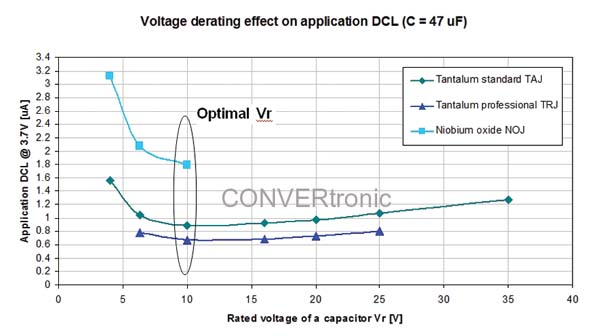
As mentioned, the typical power source for a portable device is a rechargeable lithium-ion battery with a nominal voltage Va = 3.7V. To support the device's operation, designers can choose from several different capacitor series. Figure 5 compares the maximum DCL of different capacitor series, all with a nominal capacitance of 47µF.
In this example, where Va is 3.7V, the optimal nominal voltage (Vr) = 10V (Fig. 5), meaning that the optimal operating conditions are at 37% of the nominal voltage (see Fig. 4). For different capacitances, the optimal nominal voltage will also be 10V.
Conclusion:
AVX's TRJ series of tantalum capacitors and NOJ series of niobium capacitors are suitable for battery support in portable applications and TPMS transmitters. These components exhibit different basic leakage currents, with TRJ series capacitors having the lowest DCL (Direct Current Limit). However, voltage derating can be applied to reduce the DCL to below the catalog value defined at the nominal voltage (Vr). The optimal condition for minimum DCL is to use the capacitor at 25% to 40% of its nominal voltage. For 3.7V applications, the optimal nominal voltage is 10V; therefore, the best available AVX option is to use a TRJ capacitor with Vr = 10V, closely followed by a TAJ device with the same rating. Special TAJ tantalum capacitors with the *LE suffix are also available with guaranteed minimum DCL.
Author:
By Radovan Faltus, Tantalum Technical Marketing at AVX
Eng. Radovan Faltus
Field Applications Engineer
AVX Tantalum Division