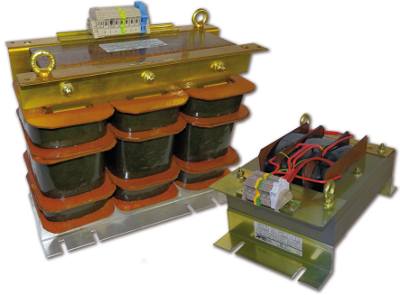
 It is worth highlighting that the most significant aspect of the new standard UNE-EN 61558-2-15:2012, which replaces UNE 20615, is the increased importance of the electrical design and the calculations performed within it to prevent power outages due to tripped protective devices, thus ensuring patient safety in these critical areas.
Therefore, it is mandatory that all transformers installed in areas such as operating rooms or intensive care units include their short-circuit voltage and the inrush current (if it exceeds eight times the nominal current) on their label or nameplate.
In this respect, AFTQ transformers have a short-circuit voltage greater than 9% and an overcurrent less than four times the nominal current, thus guaranteeing adequate primary protection and proper selectivity.
The inclusion of a winding temperature sensor in the transformer is another feature incorporated by the new regulations and the AFTQ.
It should also be noted that the design has taken into account the greatest possible safety for the patient and therefore the insulation between primary and secondary or conductive parts has been further improved, being less than 0.04 mA.
AFEISA continues to offer solutions to provide maximum security to isolated facilities with IT systems in: operating rooms, intervention rooms and other critical areas, where it is essential to guarantee a continuous power supply.