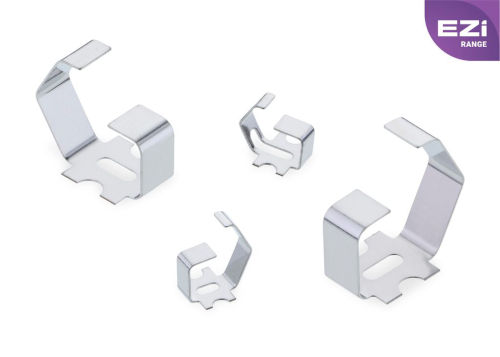
Although many spring contacts are already suitable for vertical compression applications, devices that also allow horizontal operation are less common. Therefore, multidirectional operation is attractive because the need for higher-density electronic designs means engineers require greater flexibility when connecting printed circuit boards.
Current ratings up to 14 A allow spring contacts to be used in low-power applications, as well as for signal transfer and case grounding. They are commonly used in communications equipment, consumer electronics, industrial control and monitoring systems, instrumentation, and retail tracking devices and kiosks.
Harwin's spring contacts, made from a copper alloy, provide excellent elastic properties over extended periods with a bond durability exceeding 5,000 cycles. The multidirectional contact design ensures a positive connection horizontally and vertically with the bonding surface and tolerates sweep and sliding actions. These contacts also offer the tallest vertical spring contact heights in the Harwin range, with a clearance of up to 10.00 mm and an operating height of 9.50 mm above the printed circuit board, thus providing engineers with new possibilities for vertical compression in board layout.
“Our multidirectional spring contacts provide a much more flexible method for connecting printed circuit boards in various configurations,” explains Ryan Smart, Vice President of Product at Harwin. “Since their introduction, our customers have been asking us to develop more compact, smaller, and lower-profile spring contacts, as well as taller models. This allows our customers to meet a wider range of application requirements.”.
All Harwin spring contacts are supplied on tapes and reels, making them ideal for automated assembly on printed circuit boards. Eliminating manual assembly makes this SMT product range an attractive and cost-effective solution for applications of any quantity.