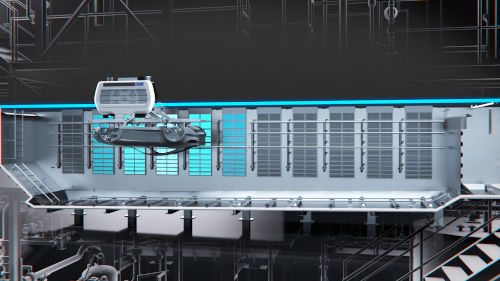
This risk no longer exists with EcoDC MACS because Dürr has divided the previously large thyristor rectifiers into numerous smaller modules, each of which supplies voltage to a small section of the tank. The failure of one rectifier no longer affects the coating quality. Since the smaller units cost only a fraction of the cost of the larger unit, the investment in replacement units is also significantly reduced.
Another advantage of the smaller unit size is that the EcoDC MACS can control anything from small groups of anodes to individual anodes. This allows for much more precise voltage regulation in the immersion bath and optimal voltage profiles, with flexible designs for a much wider range of car body models.
Dürr has increased the efficiency of the EcoDC MACS to 96% by replacing conventional IGBT (insulated-gate bipolar transistor) modules with modern silicon carbide (SiC) semiconductors. This enables higher power output with less waste heat and requires less air for cooling, resulting in energy savings. A sample calculation for a paint shop processing 58 car bodies per hour demonstrates that the difference in effective power output due to the higher operating efficiency of the SiC semiconductors is approximately 45 kW. With 20 hours of production per day, 230 working days per year and an electricity price of 0.21 euros per kWh, this translates into a reduction in energy costs of more than 43,000 euros per year, in addition to savings derived from the improvement in network quality and minimum reactive power.
Another innovation is the linear current consumption made possible by integrated Active Front End (AFE) technology. This technology balances harmonic currents that, in the worst-case scenario, could cause interruptions and shutdowns in the installation. With AFE technology, the need to invest in a separate compensation system is eliminated, as the power factor increases to approximately 1. Furthermore, active harmonic compensation ensures compliance with legal limits for power supply voltage quality.
Dürr has also optimized data transfer from the rectifier module to the control unit. Data is now transferred via a standard Profinet or Ethernet IP interface, rather than a dedicated ring bus system. This simplifies troubleshooting and ensures greater system availability. A robust bus system is also a crucial prerequisite for Industry 4.0 solutions with enhanced diagnostic capabilities.
With the new SiC rectifier modules, facility operators are prepared for the evolving requirements of future paints that may demand higher currents or voltages for coating. EcoDC MACS is designed for a higher forward current of up to 450 V DC and a higher current per rectifier mode of up to 120 A DC.
SiC rectifiers replace IGBT technology that has been on the market for about ten years, but they can also be adapted in place of conventional thyristor rectifiers.