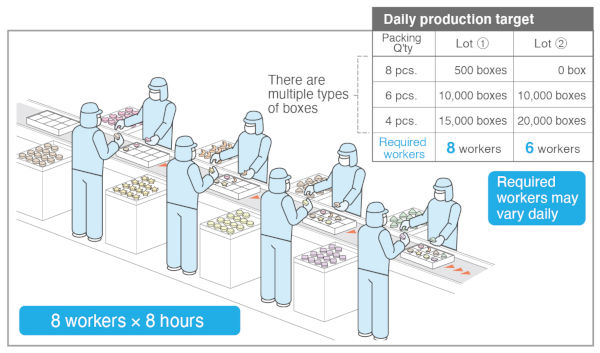
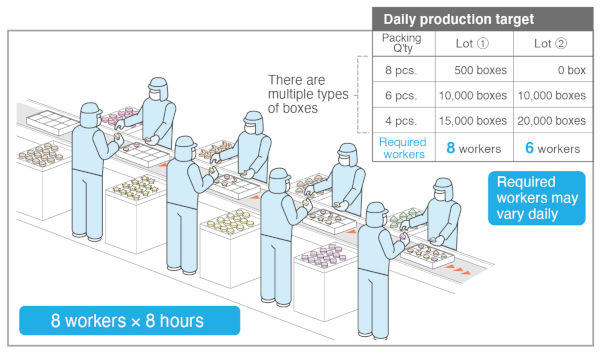
 Figure 1. Conventional manual packaging can be inefficient if there are more workers than necessary in the production area.
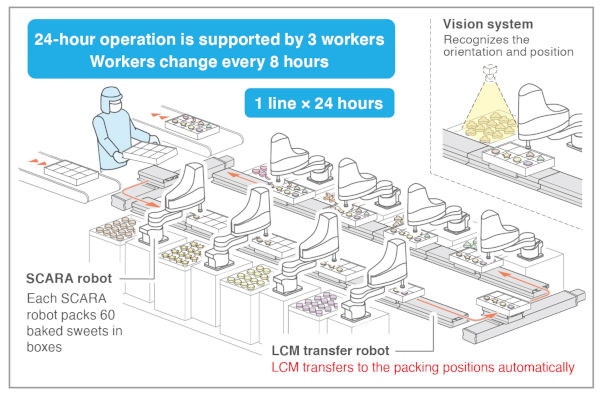
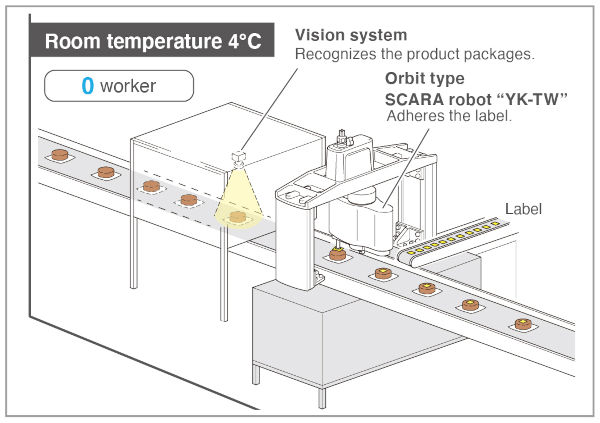 Figure 2. SCARA robots can package sweets accurately and at a constant speed, 24 hours a day, to maintain constant productivity.
They discovered that these are typically large, heavy machines that require a bridge or crane with safety anchors. Realizing this wouldn't be practical to install in the factory, they contacted Yamaha to find a more suitable solution.
 Their new orbital-type Yamaha YK-TW SCARA robot is integrated with a vision machine to recognize packages and detect the position for sticking labels (Figure 3).
Figure3. The automated system operates continuously at an ambient temperature of 4°C, maintaining constant performance and accuracy.
Specifically designed for bridge or crane mounting, the omnidirectional YK-TW eliminates the shortcomings of conventional parallel-link robots. Its relatively light weight and lower overall height result in significantly less inertia, eliminating the need for a bulky chassis. Furthermore, it comes with a purpose-designed Yamaha original mounting bracket, saving the engineering costs associated with designing a custom bridge.
“This company had never used robots before, so our team helped them conduct a preliminary evaluation with the YK-TW to confirm it would meet their requirements,” explains Jumpei Ninomiya. “Many customers choose the YK-TW because it can work in confined spaces. The R-axis can pass completely under the main unit to make the most of the workspace below, and the moving parts are optimally balanced to allow efficient, high-speed movement with consistent accuracy.”
A company spokesperson added: "Since installing our Yamaha robots, demand for our chilled and frozen products has increased. Thanks to the YK-TW's structure and assembly, we can easily change the factory layout and add additional production lines to increase capacity."
For food production, as well as semiconductor manufacturing and medical and pharmaceutical applications, Yamaha also offers a selection of clean robots, including the YK-XGC/XC SCARA, single-axis FLIP-XC, and Cartesian XY-XC. These robots meet internationally recognized cleanliness standards, such as ISO 14644-1 Class 3 and FED-STD-209D Class 10, and employ features like beltless design and air extraction to ensure low particle emissions.
"Our Yamaha SCARA robots enabled the two clients in this study to achieve their primary goal of minimizing labor costs. In each case, they were also able to improve quality and productivity, and simplify production and resource management. They were also able to rapidly increase production to capitalize on new market opportunities," summarizes Jumpei Ninomiya.
And he concludes: "For companies in the food sector, or indeed many other production and packaging industries, that first small step towards automation can start a journey that offers increasing returns through continued investment."
Article provided by Yamaha FA Section