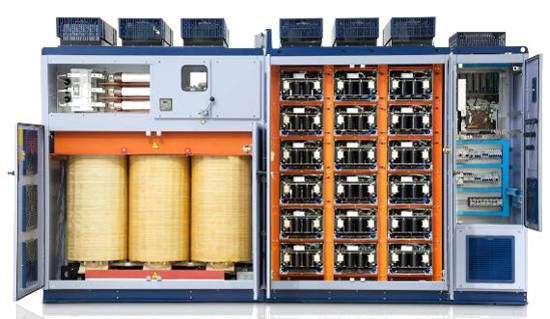
One of its main advantages is the Altivar 1200's ability to achieve energy savings of up to 40% in large medium-voltage pumps and fans. These savings allow for a return on investment (ROI) of less than two years in most cases. The unit's internal design ensures no upstream or downstream impact, and, importantly, all of this is possible without the need for external filters. Technologies that typically use these filters can cause resonances and negative torque surges, leading to unexpected vibrations and shaft failures, resulting in significant operational losses in the facilities they serve.
The Altivar 1200 features state-of-the-art technology that, as such, prevents overheating due to harmonic generation and damage to the motor's insulation. Harmonics are below 5%, meeting the most stringent recommendations, and the power factor is close to 1 without the need for external compensation. Consequently, the overhead transformer does not require derating and does not cause unexpected tripping of adjacent loads. Furthermore, its innovative multilevel technology delivers a sinusoidal signal to the motor, allowing operation over long distances between the drive and the motor without damaging the motor's insulation. Any existing wiring and motor are compatible without the need for rewinding or installing ceramic bearings, which would increase the investment and negatively impact ROI. Only the cost of the drive itself needs to be factored in.
Furthermore, thanks to the transformer's integration into the unit, the customer doesn't need to install a separate galvanic isolation transformer to prevent electromagnetic interference, nor do they need to install complex multi-pulse transformers that increase both the investment and the installation costs. This fully encapsulated solution results in a very compact, plug-and-play unit that minimizes the infamous bearing currents that can cause unwanted production downtime.
Schneider Electric integrates an automatic zero-crossing bypass circuit into its solution. This feature ensures that in the event of a power cell failure, the equipment does not stop and continues supplying power without causing torque surges. This advantageous characteristic allows for a scheduled shutdown to replace the faulty power cells. Since they are removable and interchangeable, the intervention can take between 20 and 30 minutes.
Another key factor is the use of common and well-established components and semiconductors, such as low-voltage IGBTs. Despite using low-voltage components internally and not requiring a step-up transformer, the equipment, thanks to its innovative technology, supplies a medium-voltage signal via a multi-level topology. This system is particularly advantageous as it allows for leveraging the high performance and reliability of the most widely used semiconductor on the market and enables testing without a medium-voltage power supply. This measure guarantees customers that even after the equipment is discontinued due to the product lifecycle, replacement parts will be readily available from the semiconductor market. This avoids the unpleasant situation of having to replace an entire unit simply because a semiconductor is unavailable or no longer in production.