What's most impressive is that engineers can now take advantage of Intel's innovative hybrid performance architecture. Offering up to 14 cores/20 threads in BGA and 16 cores/24 threads in desktop (LGA) variants, 12th Gen Intel Core processors deliver a significant leap forward in multitasking and scalability for next-generation IoT and edge applications.[1] They benefit from up to 6 or 8 (BGA/LGA) performance-optimized cores (P-cores) plus up to 8 energy-efficient cores (E-cores) and DDR5 memory support to accelerate multithreaded applications and run background tasks more efficiently.
Furthermore, it has been estimated that BGA processors for laptops with up to 96 integrated Intel Iris Xe GPU execution units offer remarkable improvements of up to 129% [2] in graphics performance for an immersive user experience and can also handle parallel workloads, such as artificial intelligence (AI) algorithms, compared to 11th Gen Intel Core processors.
Optimized to maximize embedded client performance, the graphics modules based on LGA processors now offer up to 94% faster performance, and their image classification inference performance has nearly tripled, with up to 181% higher throughput. [3] In addition, the modules provide massive bandwidth for connecting discrete GPUs and achieving maximum GPGPU-based graphics and AI performance. Compared to BGA versions, these and all other peripherals benefit from double the channel speed, thanks to the ultra-fast PCIe 5.0 interface technology, in addition to the processor's PCIe 4.0. Furthermore, desktop chipsets offer up to eight PCIe 3.0 lanes for additional connectivity, and mobile BGA variants offer up to 16 PCIe 4.0 lanes outside the CPU and up to eight PCIe 3.0 lanes outside the chipset.
The industrial markets targeted by both BGA and LGA variants can be found wherever high-end embedded and edge systems are deployed. This includes, for example, edge computing and IoT gateways incorporating multiple virtual machines for smart factories and process automation, AI-based quality inspection and industrial vision, real-time collaborative robotics, and autonomous logistics vehicles for warehousing and shipping. Typical outdoor applications include autonomous vehicles and mobile machines, video security, and gateway applications in transportation and smart cities, as well as 5G cloudlets and edge devices requiring AI-powered packet inspection.
“Leveraging Intel’s innovative hybrid performance architecture with impressive P-core performance combined with low-power E-core cores, Intel Thread Director allocates each workload to the appropriate cores for optimal performance. The selected processors are also well-suited for real-time applications with Intel TCC and TSN. Combined with full support for Real-Time Systems hypervisor technology, they are the ideal platform for consolidating a multitude of different workloads onto a single edge platform. Because this applies to both low-power and high-performance scenarios, it enables highly sustainable designs with a small environmental footprint,” explains Christian Eder, Marketing Director at congatec.
In addition to increased bandwidth and performance, the new flagship COM-HPC Client and COM Express Type 6 modules impress with dedicated AI engines that support Windows ML, Intel's distribution of the OpenVINO toolkit, and Chrome Cross ML. Different AI workloads can be seamlessly delegated across P-cores, E-cores, and GPU execution units to handle even the most intensive edge AI workloads. Built-in Intel Deep Learning Boost technology leverages different cores through Vector Neural Network Instructions (VNNI), and the integrated graphics support AI-accelerated DP4a GPU instructions that can even scale to dedicated GPUs. Furthermore, Intel's low-power integrated AI accelerator, the Intel Gaussian & Neural Accelerator 3.0 (Intel GNA 3.0), enables dynamic noise suppression and speech recognition, and can even run while the processor is in low-power states to wake up voice commands.
The combination of these features with compatibility with Real-Time Systems' hypervisor technology, as well as operating system compatibility with Real-Time Linux and Wind River VxWorks, makes these modules a truly complete ecosystem package to facilitate and accelerate the development of edge computing applications.
The conga-TC670 COM Express Type 6 Compact (95 mm x 95 mm) modules based on the 12th generation Intel Core mobile processor and the conga-HPC/cALP COM-HPC Client Size A (120 mm x 95 mm) modules will be available in the following configurations:
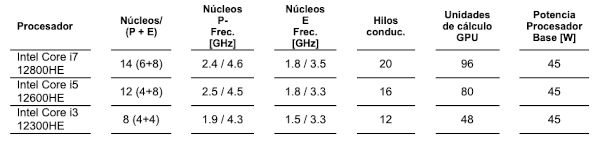
The 12th generation Intel Core processor modules for desktop computers based on the conga-HPC/cALS COM-HPC Client C size (120 mm x 160 mm) will be available in the following variants:

All these modules come with complete board support packages for all these leading RTOSs, including Real-Time Systems hypervisor support, as well as Linux, Windows, and Android.
Learn more about the conga-HPC/cALS COM-HPC Client Size C modules.
Learn more about the new conga-HPC/cALP COM-HPC Client Size A modules.
More information about the conga-TC670 COM Express Type 6 Compact modules