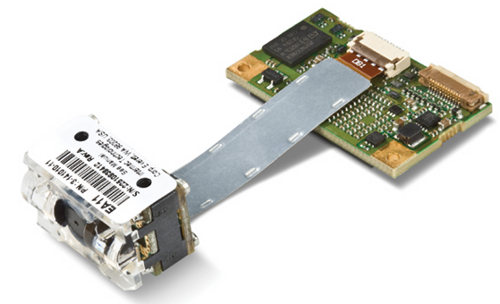
The Pcam 5C is based on the Omnivision OV5640 5-megapixel image sensor, which includes several internal processing functions such as automatic white balance, automatic black level calibration, and controls for adjusting saturation, hue, gamma, and sharpness to improve image quality.
The Pcam 5C module comes with a focus lens mounted on a standard M12 lens for easy interchangeability. It is installed on a small PCB (4.0 x 2.5 cm) with a 1x7 straight connector for accessing auxiliary camera signals. Output formats include RAW10, RGB565, CCIR656, YUV422/420, and YCbCr422.
Data transfer between the image sensor and the main development board is handled by the dual-lane MIPI CSI-2 interface, which provides sufficient bandwidth for video transmission formats such as 1080p (full HD) at 30 frames per second and 720p (standard HD) at 60 frames per second. The physical connection is a 15-pin flexible flat cable (FFC) that is pin-compatible with the popular Raspberry Pi camera connector; the Pcam 5C is supplied with a 10 cm FFC cable.
Digilent, a specialist in design tools for training, has designed the Pcam 5C specifically for use with its Zybo Z7 ARM/FPGA development board, and both are available as an integrated vision package. The Zybo Z7 board features a dual-core ARM Cortex-9 processor that incorporates Xilinx Zynq-7000 FPGA logic into a single SoC. The Pcam connector on the Z7 board enables direct communication between the image sensor and the FPGA, achieving significantly lower latency than HDMI or USB alternatives.
Because licensing is expensive and developing a MIPI CSI-2 controller implementation for FPGAs is complex and time-consuming, Digilent supplies a set of Vivado IP cores that work with the Pcam 5C on Xilinx and Zynq FPGA motherboards. Since there is no dedicated CSI-2 decoder hardware, users can observe how the FPGA performs the decoding.