This is significantly less than the 1,000 or more images required for traditional AI. The dispersed modeling kit, available from Hacarus, can be used independently or as an add-on to existing inspection systems. The main customers are vision system suppliers and systems integrators. Another user group includes machine and system manufacturers who want to use vision-based AI in their devices but have been hesitant to do so until now because the wide variety of individual customer installations requires algorithm customization, which was previously too expensive.
“With Sparse Modeling, developers can build next-generation inspection systems that can be trained to individual requirements and therefore operate anywhere. There is no longer a need for optimal conditions, such as constant lighting. OEMs also gain greater flexibility to adapt to changing production processes, which is essential for the shift to IoT/Industry 4.0-controlled batch industrial production,” explains Christian Eder, Marketing Director at congatec.
Essentially, sparse modeling is a data modeling approach that focuses on identifying unique features. Simply put, sparse modeling interprets data in a way similar to the human brain, rather than analyzing every hair and every millimeter of a person.
Humans can recognize friends and family based on key characteristics, such as eyes or ears. Sparse modeling integrates comparable logic into intelligent image processing systems. Therefore, it's not necessary to process the entire volume of big data, as is the case with conventional AI, but only a few selected data points. Sparse modeling-based algorithms reduce the data to these unique characteristics, says Hacarus CTO Takashi Someda, summarizing the benefits of sparse modeling. This also results in a much smaller AI footprint, which is ideal for low-power, non-ventilated systems that are in continuous 24/7 use and have only limited power consumption margins for integrating AI.
Starter Kit with Scalable Hardware Platform:
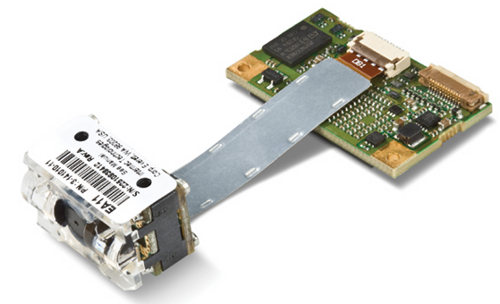
The new starter kit from congatec and Hacarus can be instantly deployed and tested in any GigE and USB 3.x environment. Designed around palm-sized CoM modules, the system measures just 173 x 88 x 21.7 mm (6.81 x 3.46 x 0.85 in). Not only is it slim, but it also delivers outstanding performance thanks to the latest Intel Atom and Celeron (codename Apollo Lake) processors currently available for mass production. Despite its small size, the system has a comprehensive I/O set, enabling many different configurations for the end user. Standard interfaces include 2 x GbE ports ready for GigE Vision applications, 1 x USB 3.0/2.0, 4 x USB 2.0, and 1 x UART (RS-232). Expansion is possible with 2 x Mini-PCIe with USIM connector, 1 x mSATA connector, and 16-bit programmable GPIO. The wide-range DC voltage input is 9V-32V.