Over the past few years, the adoption of LCDs in vehicles for instrument clusters, navigation systems, electronic mirrors, and other systems has increased significantly. The growing number of applications has also driven demand for larger, higher-resolution displays. To meet these needs, an increased number of control channels is required, which complicates system configuration and operational verification, further increasing the demand for chipset-based solutions. Furthermore, some applications, such as electronic mirrors, where malfunctions can lead to serious accidents, demand reliable functionality.
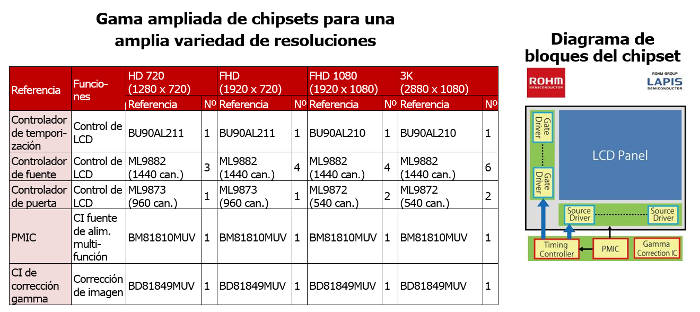 ROHM's new chipsets integrate a gamma correction IC, a timing controller (T-CON), a power supply controller, and a gate controller for HD/FHD displays (the highest resolution currently available on the market), as well as a power management IC (PMIC) that ensures optimal control. Each IC is designed to share information as needed, achieving the level of reliability demanded by the automotive industry. This marks the first time that functional safety has been successfully integrated into display devices. They also offer LCD compatibility for side mirrors and speedometers.
Chipset optimization has also allowed ROHM to cover a wide variety of specifications while integrating a fault detection function into the timing controller to verify operation, thus enabling high-resolution LCD configuration.
Main features
 1. The first automotive chipsets to offer functional LCD safety.
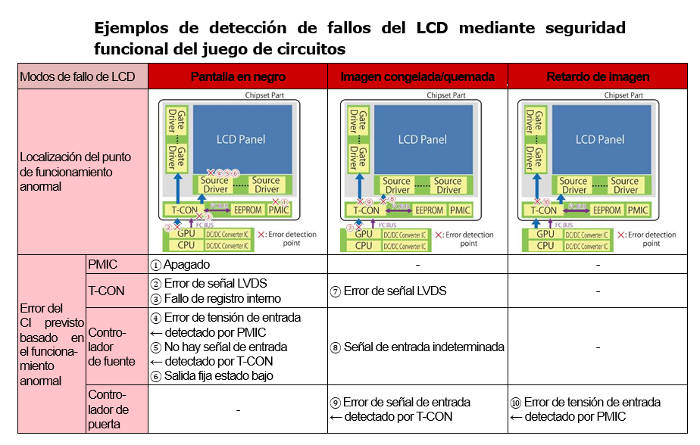
Each IC configured in the chipset integrates a function to select the expected failure mode. As a result, it is possible to detect display failures and provide information such as LCD input signals and the degree of damage or destruction to the LCD controller. The introduction of functional safety helps prevent serious accidents caused by malfunctions in the speedometer, side mirrors, and other systems.
For example, a driver might not notice that the side mirror display has frozen if no object is detected, potentially causing serious injury if someone walks behind the moving vehicle. To prevent this, ROHM offers functional safety features capable of detecting when the display image has frozen.
The PMIC incorporates a dual register to detect abnormal operation and an automatic update function to allow recovery during abnormal operation, thus ensuring a high level of reliability against unforeseen influences such as noise.
 2. Easy Configuration of High-Resolution HD/FHD LCDs:
ROHM chipsets are designed to cover a wide range of specifications, making it easy to configure high-resolution HD/FHD LCDs.
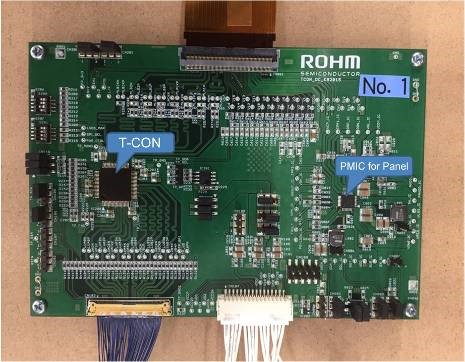
Furthermore, the timing controller features a fault detection circuit to verify chipset operation. The settings for each output on the PMIC can be changed simply by rewriting the value of the internal register. This reduces development resources and facilitates the sharing of board designs.
'
 3. Extensive support is available, including application cards.
ROHM is currently preparing manuals, reference designs, and application cards to facilitate chipset evaluation. Contact us for more information.
Terminology
HD / FHD - (High Definition / Full High Definition)
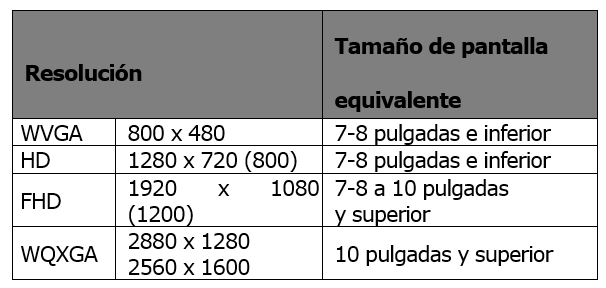
HD and FHD refer to video resolution. HD is 1280 × 720 pixels, while FHD is 1920 × 1080 pixels.
Functional safety
includes safety measures (concepts for ensuring safety) that minimize risk by adding functionality, such as monitoring and protection equipment. In the automotive market, functional safety minimizes risk to an acceptable level in order to prevent physical harm in the event of a malfunction due to an electronic system failure. There is even an international standard for automotive functional safety (ISO 26262).
Protection functions related to integrated circuits (ICs) are functions that ensure the safety of the IC itself by monitoring for internal malfunctions and damage.