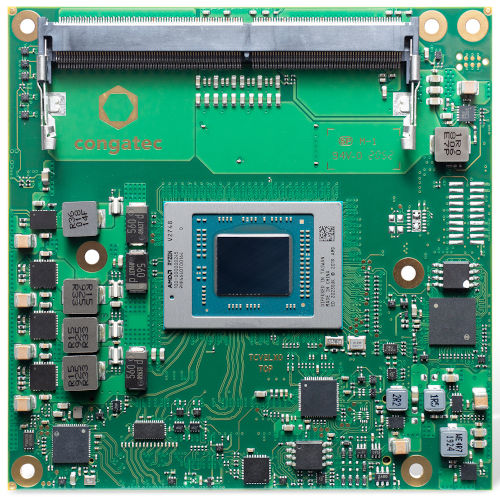
This low-power platform performance has been validated using the Cinebench R15 nt real-world, cross-platform benchmark suite. Compared to modules with AMD Ryzen Embedded V1608B processors, the conga-TCV2 modules offer a performance boost of 97% (V2516) to 140% (V2718) with up to 8 cores. Thanks to the new 7nm Zen 2 cores, single-core performance has also increased by 25% to 35%, making the new modules ideal candidates for enhancing the performance of connected, 24/7, unventilated embedded systems operating in various industrial edge environments. Typical applications include multifunctional industrial edge gateways, digital signage systems, gaming terminals, and infotainment platforms. With up to 40% more GPU capacity [2] for 4x 4K60 graphics at 15 watts and extensive GPGPU support, multi-head medical imaging systems in operating rooms, as well as machine vision and machine learning systems, are other target markets.
“While the improvements in the new AMD Ryzen Embedded V2000 processor can be used in actively cooled systems with a TDP of 54 watts, we see a significant number of customers with passively cooled, non-forced-fan systems operating at a TDP of 15 watts or even lower. The goal of operating within these limitations is to enable highly robust, sealed systems for reliable 24/7 operation in harsh environments. In those applications, performance-per-watt improvements are very welcome, and the Zen 2 x86 CPU and AMD Radeon graphics cores deliver outstanding scores in this area,” explains Martin Danzer, director of product management at congatec.
In addition to fixed-station equipment, autonomous, mobile, and solar power systems also benefit from the low power consumption of the new COM modules based on the AMD Ryzen Embedded V2000 processor, which can be configured as low as 10 watts cTDP. This is significant because productive runtime without recharging increases with lower TDPs. Competing 10-watt TDP platforms with 4 cores offer only half the number of cores, placing them in a completely different and significantly weaker performance range. Other 15-watt TDP platforms also have only 4 cores, but without the ability to reduce TDP, limiting platform balancing options. AMD Ryzen V2000 Embedded processors, on the other hand, offer an ultra-wide performance range from 10 watts to 54 watts based on this single-processor architecture.
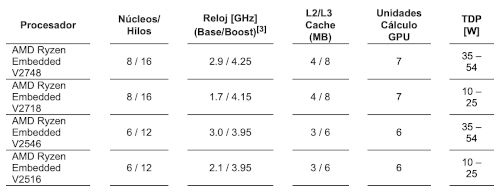 The feature set in detail:
The new high-performance conga-TCV2 COM Express Compact modules with Type 6 pinout are based on the latest AMD Ryzen Embedded V2000 multi-core processors and will be available in four different configurations (see table).
These modules offer up to twice the compute performance per watt and twice the number of cores compared to previous generations. Thanks to symmetric multiprocessing capabilities, they also provide exceptionally high parallel processing performance with up to 16 threads. The modules feature 4 MB of L2 cache, 8 MB of L3 cache, and up to 32 GB of fast and energy-efficient dual-channel 64-bit DDR4 memory with up to 3200 MT/s and ECC support for maximum data security. Integrated AMD Radeon graphics with up to 7 compute units continue to support applications and use cases that require high-performance graphics computing.
The conga-TCV2 COM module supports up to four independent displays with UHD 4K60 resolution via three DisplayPort 1.4/HDMI 2.1 ports and one LVDS/eDP port. Other performance-oriented interfaces include one PCIe 3.0 x8 slot and eight PCIe Gen 3 lanes, four USB 3.1 ports, up to eight USB 2.0 ports, up to two SATA Gen 3 ports, one Gigabit Ethernet port, eight GPIO I/Os, SPI, LPC, and two legacy UART ports provided by the onboard controller.
Supported hypervisors and operating systems include RTS Hypervisor, Microsoft Windows 10, Linux/Yocto, Android Q, and Wind River VxWorks. For security-critical applications, the integrated AMD Secure Processor assists with hardware-accelerated encryption and decryption of RSA, SHA, and AES. TPM support is also included.
[1] Testing conducted by AMD Performance Labs as of July 2020 on the Ryzen Embedded V2718 processor and June 2018 on the Ryzen Embedded V1605B processor, both at 15 watts (STAPM mode enabled) using Cinebench R15 nt. Results may vary. EMB-170
[2] Testing conducted by AMD Performance Labs as of July 2020 on the Ryzen Embedded V2718 processor and June 2018 on the Ryzen Embedded V1605B processor, both at 15 watts (STAPM mode enabled) using 3DMark11. Results may vary. EMB-172
[3] Maximum boost for AMD Ryzen and Athlon processors is the maximum frequency achievable by a single processor core running a burst single-threaded workload. Maximum boost will vary depending on several factors, including thermal paste, system cooling, motherboard design and BIOS, the latest AMD chipset driver, and the latest operating system updates. GD-150