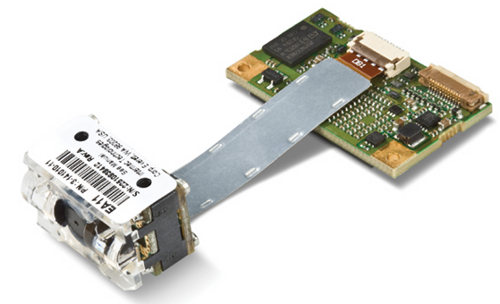

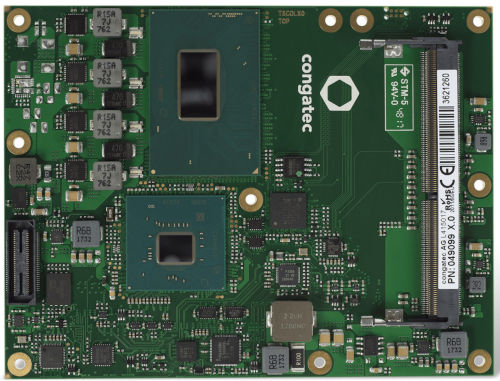
This allows congatec to offer all 10 new processors in a single COM Express module design: the conga-TS370. There are now a total of 14 processor module variants available in this microarchitecture, offering extremely broad scalability. The flagship in terms of computing power is the 45-watt, 6-core module with a 2.8 GHz Intel Xeon E-2276ME processor, delivering the highest embedded computing performance with the highest-performing processor graphics currently available worldwide. Meanwhile, the 35-watt, 2.4 GHz Intel Celeron G4930E processor module sets a new benchmark for price and performance.
Of particular note are the two 6-core Congatec modules with a TDP of 25 watts offered with the Intel Xeon E-2276ML and Intel Core i7-9850HL processors. These allow developers to create embedded edge computing systems with completely passive cooling that can run up to 12 independent virtual machines in parallel thanks to Hyperthreading. This enables operation even in completely sealed systems, under the harshest environmental conditions, and with maximum IP protection. The same applies to the two quad-core modules with the Intel Xeon E-2254ML or Intel Core i3-9100HL processor, as well as the module based on the Intel Celeron G4932E processor, all with a partially configurable TDP of 25 watts.
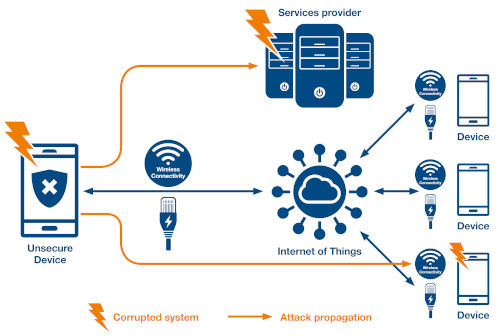
“In the embedded edge computing segment, our OEM customers are now using these multi-core platforms to consolidate several previously separate systems into a single embedded edge computer. Hypervisor technology allows them to run up to 12 virtual machines in parallel on a single system,” explains Andreas Bergbauer, Product Line Manager for COM Express modules at congatec. “These include real-time controllers (software PLCs), Industry 4.0 gateways for touch internet over time-synchronized networks, IoT gateways for sending big data to the cloud and central management systems, as well as vision systems, artificial intelligence (AI), and machine learning applications. In addition, there are software-defined networking functions, such as intrusion prevention and detection systems, that analyze data traffic in parallel with applications, thus avoiding the latency that would arise from running analytics and applications sequentially.”.
Other applications, besides embedded edge computing, include, of course, high-end medical imaging and HMI systems, as well as high-end digital signage and gaming systems that require best-in-class computing power and performance on a single chip in tandem with Intel graphics technology.