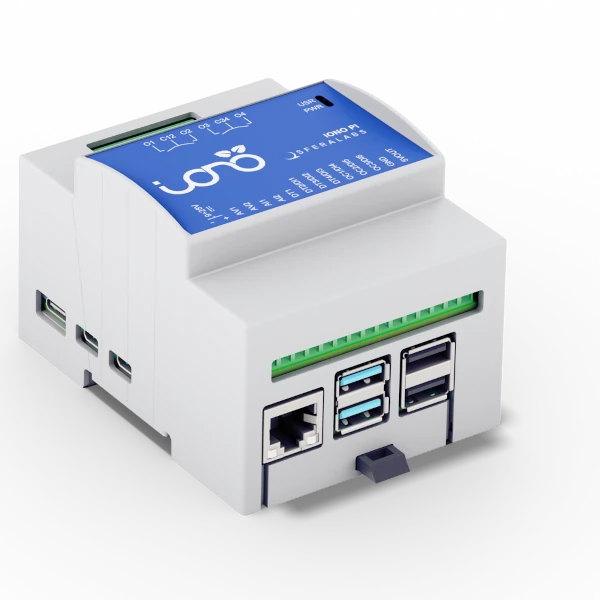
Four power relay outputs (5 A at 250 V AC), six protected digital inputs (0-40 V) and three open collector outputs with integrated fault detection cover the I/O requirements of a wide range of process control and building automation tasks.
The most significant measurement improvement in version 3 is the replacement of the 12-bit analog-to-digital converter (ADC) from version 2.0 with a 16-bit Microchip MCP3462 converter with a speed of up to 153.6 ksps. Two analog voltage inputs (0-30 V) and two analog current inputs (0-20 mA) are connected to the same high-resolution converter. For applications requiring accurate process measurement or fast signal acquisition along with Linux-based control logic, this integrates capabilities that previously required separate, dedicated hardware into a single DIN rail device.
The Iono Pi v3 includes an NXP PCF2131 real-time clock with a temperature-compensated crystal oscillator (±3 ppm accuracy) that also functions as hardware monitoring. If the Raspberry Pi operating system becomes unresponsive, the PCF2131 performs a full power-up cycle, regardless of the software running on the Raspberry Pi. A timed power control feature allows for scheduled sleep/wake cycles for low-power remote installations.
The Microchip ATECC608 secure element provides hardware cryptographic key storage and other standard cryptographic functions, enabling device-level identity and authentication for IIoT implementations where software security is insufficient.
Seven bidirectional 5V GPIO lines support 1-Wire temperature sensor networks (DS18B20), Wiegand access control readers, and general-purpose I2C devices. A 5V auxiliary output with a 500mA capacity—ten times greater than the 50mA of version 2—powers multi-sensor networks without requiring a separate power supply. The device operates on 9–28V DC, features surge and reverse polarity protection, and is housed in a 4-module DIN rail enclosure.
A Raspberry Pi OS driver exposes all the functions of the Iono Pi v3—relay control, analog measurement, digital I/O, watchdog timer, and RTC—through the sysfs file system, enabling control from any programming language. It complies with CE, FCC, and IC standards