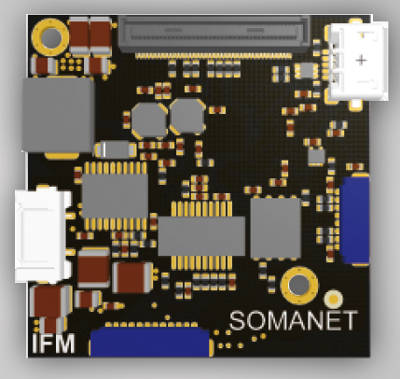
 It is part of the SOMANET modular system for real-time distributed systems, with which Synapticon offers the first platform for developing cyber-physical systems and working on flexible automation solutions and autonomous robotic systems. Like all SOMANET modules, the new sensor module can be combined with various communication modules and CPUs from the SOMANET family as nodes in a distributed system.
The SOMANET IFM GPIO-A/USB features four analog inputs, ten isolated digital inputs and outputs, three non-isolated digital I/Os, and a USB interface. The analog-to-digital converter has a 12-bit resolution and a sampling rate of 1 MSPS. For local sensor data processing, it has an 8-core, 32-bit XMOS processor with a clock speed of 500 MHz and an 8 MB SDRAM buffer. Furthermore, the new SOMANET module enables the use of both analog and digital sensors in cyber-physical systems and flexible automation solutions. Combined with the SOMANET processor and communication modules, the new sensor module becomes a powerful node for distributed systems capable of recording analog and digital data, processing it locally, and communicating the results.
SOMANET modules allow nodes to be combined for various real-time tasks, creating a modular system. Several "Core" modules generate scalable local computing power via XMOS processors. "COM" modules handle communication (EtherCAT, WiFi, CAN bus, etc.). "The IFM, short for Interface Module, establishes the connection to the real world for each of the small nodes," explains Nikolai Ensslen, CEO of Synapticon GmbH. "These are interfaces for actuators, such as field-oriented controllers for brushless DC motors, or for sensors. Having an analog interface in addition to the purely digital ones is a major step toward completing our SOMANET hardware platform."





- Details
- Category: Embedded Systems
Powerful sensor module for mounting cyber-physical systems
Synapticon GmbH presents a new sensor board. The SOMANET IFM GPIO-A/USB module, measuring just 35 x 35 x 7 mm, features four analog inputs, a high-resolution analog-to-digital converter, 20 digital I/Os, a USB interface, and an 8 MB data buffer.


Print Magazine

Annual subscription price:
You will receive all 10 editions that are published each year.
social networks
Popular News Electronics


Spanish electronics magazine. Printed for over 25 years.
Spain - Madrid - All rights reserved © Convertronic Professional Spanish Electronics Magazine.