

Red Pitaya's technology is trusted by innovators such as NASA, Apple, Meta, Neuralink, Toyota, Volvo, and Nokia, and is used by over 400 universities and schools worldwide. With a user base of more than 45,000 customers, Red Pitaya has established itself as a leading platform for precision engineering. The company creates high-performance computing solutions designed to be versatile, scalable, and easy to use, making them valuable for both advanced industrial applications and educational environments.
This next-generation series improves performance and reliability while maintaining full backward compatibility, ensuring a smooth transition for existing users. With enhanced features such as improved RF input performance, USB-C connectivity, and a compact design, the Gen 2 series is engineered to simplify signal acquisition, generation, and processing across a wide range of applications. Whether used in educational settings for hands-on learning or in professional industrial or scientific environments for complex test and measurement tasks, the Gen 2 series provides users with the tools they need to innovate and excel in their respective fields.
“Engineers need modular and adaptable platforms that evolve with technology,” says Mateja Lampe Rupnik, CEO of Red Pitaya. “With STEMlab 125-14 Gen 2, we offer a more powerful system that meets industrial performance requirements while remaining true to our vision of flexible, software-defined instrumentation.”.
The Gen 2 series consists of three distinct models: STEMlab 125-14 Gen 2, STEMlab 125-14 Pro Gen 2, and STEMlab 125-14 Pro Z7020 Gen 2. All offer improved RF input performance with less noise, crosstalk, and distortion, an improved output voltage range of ±1 V into 50 Ω and ±2 V into high impedance, and modern USB-C connectivity.
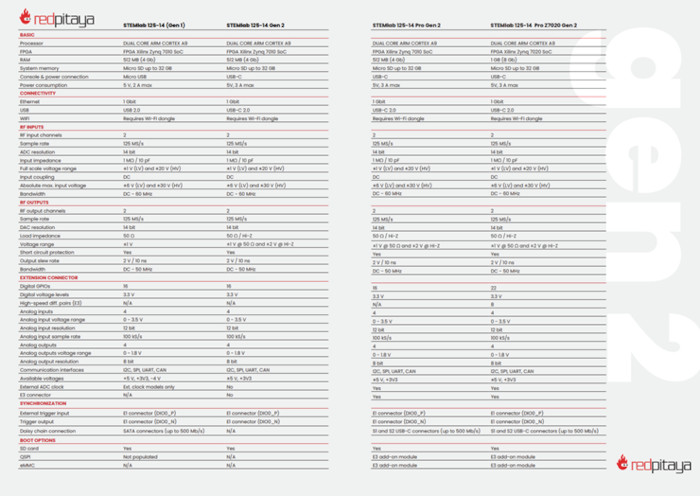
The STEMlab 125-14 Pro Gen 2 is designed for demanding applications in industrial environments. It features an E3 connector that offers more reliable boot options (QSPI, eMMC), an integrated external clock selector for precise timing control, and multi-channel synchronization via USB-C connectors.
Finally, the STEMlab 125-14 Pro Z7020 Gen 2 is designed for the most demanding industrial and scientific tasks. It features double the DDR memory (1 GB) for longer capture times, a significantly larger FPGA (Z7020) for enhanced processing capabilities, additional GPIOs on E1 for expanded functionality, an E3 connector providing more reliable boot options (QSPI, eMMC), and eight more high-speed differential pairs. This model is particularly well-suited for cutting-edge applications such as quantum computing experiments, photonics technologies, medical imaging advancements, space applications, and sophisticated OEM solutions.
Red Pitaya is also working with Texas Instruments to develop a low-latency board optimized for real-time control systems, radar, and LiDAR applications. More details about this partnership will be announced later this year.
“With the Gen 2 line, we are transforming the landscape of software-defined modular instrumentation,” added Črt Valentinčič, Chief Technology Officer at Red Pitaya. “By working closely with industry leaders and proactively engaging with our growing user community, we are delivering innovative solutions specifically designed for industrial needs. Our offerings feature superior performance, enhanced reliability, and are aligned with the latest technological advancements.”.
Red Pitaya's modular approach allows developers to customize, scale, and integrate STEMlab 125-14 Gen 2 across a wide range of industries, from research labs to industrial automation. As the demand for flexible, software-defined instrumentation grows, Red Pitaya continues to push the boundaries of performance and affordability in precision engineering.