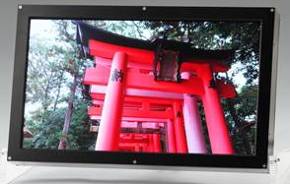
 The new display utilizes NLT's proprietary Super Fine TFT2 (SFT2) technology, comparable to In-Plane Switching (IPS) and an evolved version of NLT's wide-viewing-angle Super Fine TFT technology. By making radical modifications to the wires, electrodes, and other aspects of the pixel design, NLT has achieved an ultra-high aperture ratio to attain 180% higher transmissivity levels than conventional technology, even in high-density LCD panels.
The new screen includes the following features:
(1) Low Energy Consumption:
By improving the panel's light utilization efficiency, high luminance is achieved while maintaining low energy consumption. This, combined with an optimized backlight design, allows for reduced energy consumption, offering energy savings of approximately 35% compared to existing displays.
(2) Reduced Heat Generation:
Due to the drastic reduction in the amount of energy consumed by the backlight, the amount of heat generated by the LCD module is also reduced. This eliminates the need for a cooling fan in the monitor and allows for a reduction in the size of the heat dissipation slots, thus presenting fewer limitations to the system design.
(3) Wide Color Gamut:
NLT's new SFT2 technology combines exceptional viewing angle characteristics with high transmissivity. A wide color gamut (NTSC ratio above 80%) is achieved without sacrificing luminance. Furthermore, SFT2 technology suppresses color shift when viewed from an angle. The LCD module provides display characteristics suitable for high-end applications—such as broadcasting, graphic design, and medical imaging—that require high-quality color reproduction.
In recent years, displays used in industrial and medical applications have shown a trend toward higher density and luminance to deliver better image quality. However, the backlights used in high-density displays cause high-luminance LCDs to consume more energy. Considering the environmental impact and system maintenance costs, reducing energy consumption is essential.
SFT2 technology dramatically improves the light utilization efficiency of the LCD panel, delivering excellent luminance and resolution with low power consumption. Because the module generates less heat, it doesn't require a cooling fan, and the heat dissipation slots require less area than in conventional modules. Consequently, the monitor's footprint can be reduced by using this panel.
To meet the high level of demand in the medical and industrial fields, NLT continues to develop display solutions, offering improvements such as wider viewing angles, higher image quality, and lower power consumption.