The perception of a good product often stems directly from the appearance of the front panel or graphical user interface: Is it visually appealing? Is it functional? Is it easy to use? For electronic systems and equipment requiring a graphical user interface, TFT LCD display modules have become a widely used option.
For the design engineer, technical specifications are very important, but display panels are always chosen for their visual appeal. The aesthetic characteristics of the on-screen image and the resulting user experience must be seriously considered.
IPS (In-Plane-Switching) TFT display technology exhibits the two main limitations of a standard TN (Twisted Nematic) TFT display: limited viewing angles and poor color reproduction.
Screen readability:
The ability of a screen image to be easily seen is known as screen readability. This is influenced by a number of factors that affect the screen's optical performance. A screen's optical performance is measured by its brightness and contrast.
Brightness is defined by the amount of radiated light emitted from the screen. Brightness is measured in candelas per square meter (cd/m²) or nits (where 1 cd/m² = 1 nit).
 Contrast is defined as the ratio between the luminance of the brightest color (white) and the darkest color (black) that the screen is capable of producing. Generally, the higher the contrast ratio, the easier it is to see the image on the screen.
Twisted Nematic (TN)
TFT mode is the workhorse of TFT display technology. In a TN TFT display, the liquid crystal molecules are aligned with the upper and lower glass substrates. The LC (Liquid Crystal) molecules align parallel to the friction direction of the alignment layer. The friction direction of the alignment layers of the two substrates is perpendicular to each other, creating a 90-degree twist (tangle) in the liquid crystal.
When a voltage is applied across the LC cell, the liquid crystal molecules unwind and align along the vertical electric field. A fundamental limitation of TN technology is that the alignment of the liquid crystal molecules changes the further they are from the optical electrode. This can impact light transmission through the cell, resulting in reduced contrast, brightness, and color definition at wider viewing angles.
Vertical Alignment (VA)
Vertical alignment was originally developed to address the limitations of TN mode technology. In VA displays, the liquid crystal material is naturally vertical. Without applied tension, the liquid crystal molecules remain perpendicular to the substrate. When tension is applied, the liquid crystal cells shift to a horizontal position, parallel to the substrate, allowing light to pass through.
VA has achieved wide viewing angles and high contrast, but with a reduction in brightness and normal color reproduction. Current VA panels can offer wide viewing angles—second only to IPS technology—good black levels, and good color reproduction. When VA panels are viewed from an angle, there is some color shift, but much less than with TN panels.
Multi-Domain Vertical Alignment (MVA) and Super Pattern Vertical Alignment (SPVA) panels have addressed some of the limitations of VA technology. Both technologies offer improved contrast, especially at wider viewing angles.
In-Plane Switching
(IPS), developed and first introduced by Hitachi Displays Ltd in 1996, was the first LCD technology to deliver exceptional image quality, especially when viewed from any angle. IPS technology offers outstanding color saturation, color stability, contrast, and black levels with a 176° viewing angle both vertically and horizontally.
 In an IPS TFT display, the liquid crystals are aligned horizontally to the glass substrate. Both electrodes are aligned horizontally on the lower substrate. When a voltage is applied between the electrodes, the liquid crystals rotate horizontally and remain parallel to the electrodes and the glass substrate of the display. The liquid crystal molecules are able to move freely in the required alignment. This approach keeps the liquid crystals parallel to the front of the panel, providing a wide and symmetrical viewing angle.
A Brief History of IPS Technology:
The core of IPS technology has evolved into Super-IPS (S-IPS), Advanced Super-IPS (AS-IPS), and most recently, IPS-Pro in 2008. Super-IPS was introduced in 1998 to combat the color shift that was still evident at wide viewing angles of the original IPS displays. More recently, with IPS-Pro, a significant advancement was the refinement of the optical electrode pattern and structure, and a change from opaque to transparent electrodes.
Medical, broadcast, and professional monitoring applications demand exceptional optical performance from a display. The latest evolution of IPS-Pro features display modules that deliver highly stable color images with excellent color saturation and high contrast ratios from any viewing angle. Deeper black levels, combined with improved transmission, provide contrast ratios of up to 1200:1. These features also allow for high brightness without increasing the power consumption of the backlight unit.
Hitachi's continuous improvement of IPS LCD technology now offers significantly higher and more stable image performance at all viewing angles than any other TFT technology.
Why use IPS?
IPS LCDs are widely used by multinational blue-chip companies in the manufacture of high-performance, mass-market consumer products such as smartphones, tablet PCs, monitors, and televisions. Smaller companies in niche industrial markets are now able to benefit from IPS technology as a standard, as standard TFT displays have become more readily available.
The demand for wide-viewing-angle and wide-field-of-view displays has increased. Many applications now require highly consistent optical performance and accurate image reproduction. Contrast and color characteristics must be maintained across a wide range of viewing angles and positions.
 When viewed from a sharp angle, a conventional TFT screen exhibits a loss of brightness, and the image colors may appear inverted. In certain applications, this performance limitation is not critical, such as on a laptop where the user is typically positioned perpendicular to the TFT screen. However, in medical imaging systems and broadcasting systems, the image seen by one person may be perceived differently than the image seen by a second person in an alternative viewing position.
IPS TFT technology overcomes the limitations of conventional TN TFT display technology and offers the following advantages: wide viewing angles, accurate color reproduction, virtually no color shift, and deeper black levels.
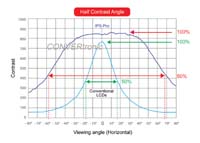
The diagram in Figure 2 illustrates the improved viewing angles of IPS-Pro compared to other wide-viewing-angle technologies. In particular, it is important to consider the viewing angles achievable at 50% contrast. This is known as the Half Contrast Angle (HCA), which is a more realistic measure of wide-angle performance. The maximum contrast ratio is experienced when viewing the screen perpendicularly.
The Future of IPS Technology:
TFT technology, in its various forms, has been around for over 30 years. It remains a highly effective, efficient, and cost-effective technology. LCD development continues apace with further improvements to enhance all aspects of its performance.
OLED has been heavily marketed and promoted as the next sustainable, long-term alternative to LCD technology. However, it is still viewed as an immature technology with ongoing technical challenges, such as achieving a consistent and long product lifespan. To date, OLED usage has been limited to mass-market consumer applications such as digital cameras and smartphones.
TFT IPS technology has notable advantages over traditional TFT TN technology and other competing TFT technologies and is becoming the most common in a wide range of applications requiring consistent and accurate display reproduction, such as medical equipment, marine navigation, digital signage, and industrial process control.
It is highly likely that IPS TFT displays will continue to offer a highly viable display technology, providing market leadership in optical performance. Therefore, to ensure the best user experience, an IPS TFT display should be considered.
Author: Mark Stephenson, Director of Product Marketing at Hitachi Display Products Group