

Both solutions are designed to combine artificial intelligence inference, image processing, navigation, control, and communications tasks on a single platform.
The architecture, based on the Dragonwing IQ-9075M, distributes workloads across the CPU, GPU, NPU, and dedicated image processing resources.
Advantech divides the robotic functions supported by the platforms into three main groups: perception, planning, and control.
Perception includes image acquisition via cameras, AI inference, processing of information from LiDAR and IMUs, and sensor fusion. Planning encompasses tasks such as localization, navigation, trajectory updates, and application logic execution.
For control functions, the platforms provide interfaces such as CAN bus, Ethernet, USB, digital I/O, and serial connections.
This architecture allows different parts of the robotic workload to be executed using the computing resources available on the same system.
The ASR-A503 is geared towards manufacturers and developers who need to integrate the computing platform directly into their own robotic designs.
According to specifications provided by Advantech, it delivers up to 100 TOPS in dense operations and 200 TOPS in sparse operations for locally processed AI and vision workloads.
The distinction is important: the 200 TOPS corresponds to workloads leveraging sparse operations, so it should not be directly equated with the 100 TOPS specified for dense operations.
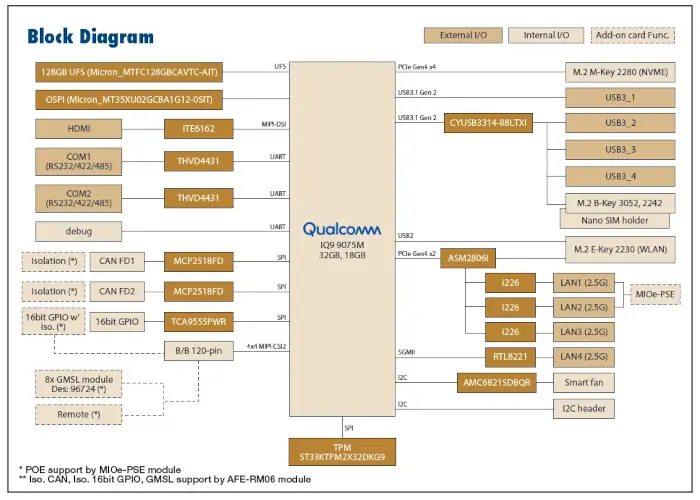
The board features GbE, USB, and CAN FD connectivity, as well as digital I/O, serial interfaces, and M.2 expansion.
Optional GMSL connectivity is also available for integrating cameras and other image acquisition devices.
The AFE-A503 utilizes the same processing platform in an integrated industrial controller.
The system incorporates computing electronics along with a housing, power input, isolated interfaces, thermal system, and connectivity.
Advantech primarily targets it for autonomous mobile robots and robots used in production environments, where these components must be integrated into a unit ready for machine installation.
Among the capabilities specified for the platforms is the connection of up to eight camera inputs via GMSL and MIPI-CSI.
This configuration is geared towards robotic systems that need to simultaneously acquire information from multiple cameras for perception and machine vision tasks.
The architecture allows these inputs to be combined with the SoC's AI capabilities to locally execute image analysis tasks, while other processor resources handle navigation, planning, and control.
The features listed by Advantech include isolated CAN FD and 16-bit digital I/O, as well as four Gigabit Ethernet ports with PoE capability.
The power input supports voltages from 20 to 36 VDC.
The platforms also incorporate ECC memory and TPM 2.0, along with protection mechanisms against electrostatic discharge (ESD) and overvoltage.
Advantech specifies an operating temperature range of -40 to 85 °C, intended for use in industrial environments and robotic systems subject to varying thermal conditions.
The ASR-A503 and AFE-A503 are compatible with Advantech Robotic Suite, the company's software environment for developing and deploying robotic applications.
Combining the two platforms allows the same Dragonwing IQ-9075M processing base to be used in two different formats: a board designed for specific integrations and an industrial controller that incorporates the necessary elements for installation as a complete system.