



Until the 1990s, railways were primarily equipped with functional amenities such as seating and stop devices. Modern railways offer passengers greater comfort through Wi-Fi, passenger information systems, video surveillance, and targeted advertising on screens. The additional use of video surveillance is also appreciated by railway operators, for example, in incident investigations.
In long-distance transport, trains have also become "rolling workplaces": integrated tables in the seats offer the possibility of working on the go, and Wi-Fi internet access allows for participation in virtual meetings. This increased demand for flexibility and mobility during transport also includes the desire for real-time journey information. For operators
, the collection of additional data through predictive maintenance is important to ensure better train upkeep.
Passenger counts provide them with additional information for planning and control. Real-time diagnostic monitoring, for example, of the air conditioning or water levels in the train's restrooms, is also standard on modern trains.
Cybersecurity regulations under EU Cyber Resilience Act 2019/1020 of 2022 are also becoming increasingly important to ensure secure hardware and software products. Due to the rise in cybercrime resulting from increased connectivity, train networks must also be protected. Information systems certified to the specified security standard IEC 62443 for industrial control and automation systems provide guidance.
In principle, both when retrofitting existing trains and when producing new trains, it is important to consider future vehicle technology by installing appropriate hardware.
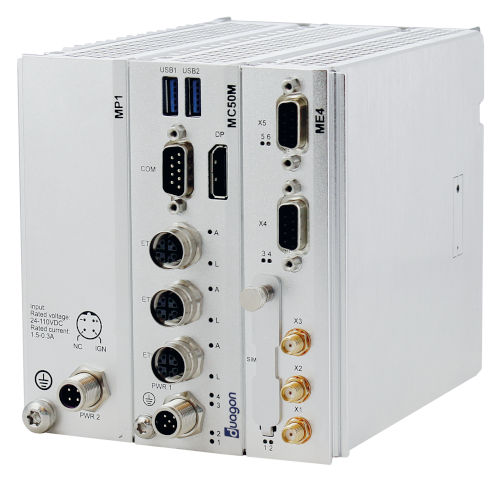
A single computing unit for all communication tasks on the train.
To meet the requirements of modern vehicle technology and the highest standards of passenger safety and comfort, one area of railway vehicle retrofitting includes upgrading the network technology. This allows for the integration of a computer platform for communication tasks on the train (Train IT Server). Among other things, it can be used to retrieve passenger information in real time, access the internet via Wi-Fi, and detect malware on the railway network through intrusion detection performed by the Train IT Server.
By using additional virtualization software, various applications such as passenger counting, predictive maintenance, and passenger information systems can also run on a single computer. Rail operators benefit from reduced costs and increased operational efficiency, as only one computer is needed on the train instead of several.
Another important aspect of rail operations is long-term availability, guaranteed by manufacturers for at least 15 years. Furthermore, existing trains can be retrofitted with new hardware and repaired to achieve a uniform standard across the entire fleet. The use of modular hardware allows for future upgrades to computing power, integrated interfaces, the installation of larger data storage devices, and the updating of mobile communication standards.
Computer Server for Trains: Powerful, Long-Term Availability, and Modular.
To meet the diverse requirements of the rail and transportation industry, high-performance IT platforms are being adopted for the rail sector. The hardware used in the rail sector must be especially robust to withstand extreme ambient temperatures from -40 to +85 °C, strong temperature fluctuations, vibrations, and shocks. At the same time, a space-saving implementation must be provided.
For a long service life, the number of plug contacts should be kept to a minimum, and exposed cables should be avoided. The Duagon Train IT Server was developed with these considerations in mind. It is a combination of a rack with a suitable power supply, computing unit, local storage, and various modular and scalable I/O modules. Depending on the application, whether for local or long-distance transport with greater computing power, different units and computing systems are available, including DIN rail or 19-inch rail systems.
For small and medium-sized computing environments, DIN rail systems have been designed with Intel® Dual or Quad Core CPUs and up to 8 GB of RAM and I/O modules. Up to two modems with 5G mobile capabilities can be operated.

Part of the Train IT server is a 3U CompactPCI Serial CPU board with 11th generation Intel® Core™ and Intel® Xeon® W-11000E processors. Equipping the computers with 11th generation Intel® Core™ processors ensures reliable data processing and long availability until 2032. With 4 to 8 cores, a powerful graphics processor, and fast 64 GB of DDR4 DRAM with ECC, the 19-inch systems are designed for high-end embedded systems on trains and tracks. Optional 10 Gbit Ethernet interfaces enable high data throughput and direct connection to the backbone network. Up to six 5G mobile modems can also be installed, operating within the train's IT server. Each duagon server is robust, modular, flexible, and individually configurable. All train server combinations are fully certified and meet the highest requirements of the EN50155 railway standard and, in collaboration with railway operators, the highest software security level 3. An integrated fan unit ensures long-term operation by keeping system temperatures low, thus guaranteeing a longer lifespan.
Virtualization platforms exist that allow railway operators to run different applications and operating systems on a single unit. These platforms support Intel VT-x and VT-d virtualization technologies. This allows for the replacement of individual computers on the train and, consequently, reduces maintenance costs.
Redundant operation, in which two systems run in parallel, simultaneously ensures operational reliability: if one computer fails, the other continues to function.

Safety and long-term availability are the focus of the rail industry.
Demands on rail management are constantly increasing due to the technological upgrades required for operational safety, the challenge of cybersecurity, and the ever-growing importance of passenger comfort. Rising passenger comfort expectations are driving advancements. Train manufacturers are already offering their customers uniform, future-proof platforms for a variety of future-oriented applications. Robust IT platforms, such as the duagon train IT server, offer predictability during operation. Depending on the requirements, it can be individually adapted, retrofitted, and is available long-term.
 Author: Robert Blankenhorn, Senior Solution Architect at duagon.