




compared to comparable CPUs, ensuring reliable and scalable computing power for industrial automation, machine vision, robotics, medical imaging and local AI processing applications.
Through this efficient architecture, Advantech introduces the AIR-420 compact on-premises AI HPC system and the AIMB-523 industrial Micro-ATX motherboard. Both support up to 64GB of dual-channel DDR5 5600 ECC memory configurations, PCIe Gen5 compatibility, wide TDP ranges, and Advantech’s software suite, which includes GenAI Studio, SUSI API, and DeviceOn. Together, these EPYC Embedded 4005 products deliver next-generation bandwidth, expandability, and performance, while accelerating the evolution of applications for increasingly latency-sensitive on-premises workloads.
The AMD EPYC Embedded 4005 Series delivers server-grade performance with up to 16 cores in compact industrial platforms, featuring deterministic computing, 1.44x higher performance per watt, and flexible TDP options from 65 to 170 W. It also supports high-performance data processing and real-time responsiveness with up to 128 MB of L3 cache. This platform offers exceptional compute density and versatile expansion capabilities, making it ideal for industrial applications that require high bandwidth, low latency, and rapid system integration.
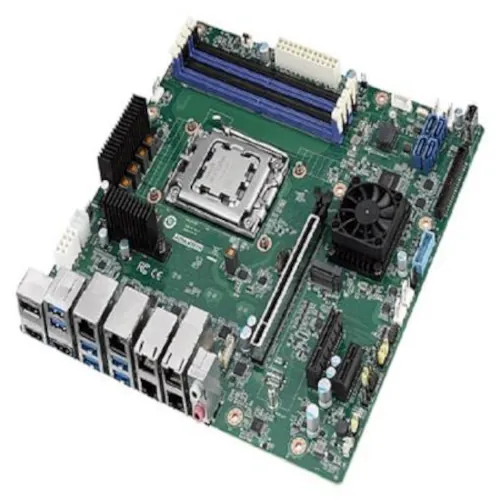
Designed for on-premises AI deployment, the AIR-420 delivers server-grade performance in a compact, quiet, and industrial-grade form factor. Its space-optimized thermal design accommodates physically constrained environments, while redundant power supplies ensure high availability for mission-critical operations. Supporting dual GPUs, the AIR-420 handles light-to-medium workload AI inference, machine vision, and real-time analytics. With its compact size, redundancy options, and dual-GPU expansion capabilities, the AIR-420 is one of the most capable systems for intelligent automation and AI-driven production. The AIMB-523 is a high-performance Micro-ATX motherboard designed for on-premises AI workloads and next-generation 3D inspection. Based on the AMD EPYC Embedded 4005 platform, it offers robust computing performance, PCIe Gen5 expandability, and support for high-speed DDR5 memory. Its comprehensive I/O design includes up to six 2.5 GbE ports (two with PSE), eight USB 3.2 ports, and a vertical USB 2.0 port.

Thanks to its balanced combination of performance, bandwidth, and functionality, the AIMB-523 provides a scalable and reliable foundation for vision-guided manufacturing, semiconductor inspection, and advanced medical imaging applications.
The AMD EPYC Embedded 4005-based product line is validated for both Windows Server IoT and Ubuntu LTSC and supports value-added software solutions, including:
DeviceOn: Enables AI application development, edge deployment, remote monitoring, and I/O control.
SUSI API: Improves operational efficiency through advanced device maintenance and control features, ensuring maximum availability.
Edge AI SDK: Accelerates inference performance evaluation in turnkey solutions with hardware/software packages and plug-and-play support.
GenAI Studio: Includes a no-code graphical interface that simplifies LLM model training.
Advantech Custom Design Service: Facilitates integration across multiple applications through expert advice, technical support, and customized solutions.
The AIMB-523 motherboard, based on AMD Ryzen™ Embedded 7000/9000 and EPYC Embedded 4005 series processors, offers multiple expansion options via PCIe x16 Gen5, PCIe x4 and x1, as well as M.2 M-Key for NVMe. It supports up to 128GB of dual-channel memory with four 5600MHz DDR5 UDIMM modules, up to six 2.5GbE ports (two with PSE functionality), eight USB 3.2 ports, one USB 2.0 Type-A riser port, and four COM ports. The compact AIR-420 chassis boasts a reduced 28.6L volume and supports two 3.9-slot graphics cards. Based on AMD EPYC/Ryzen processors with AI processing capabilities, it features a redundant power supply and multi-fan system for enhanced reliability, an intelligent fan control algorithm for optimal noise management, and integrated GenAI Studio for LLM modeling applications.



