




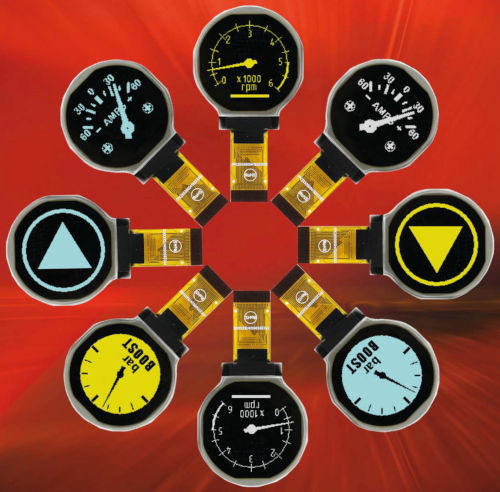
The external dimensions of the entire module, including the connecting cable, are approximately 37 x 41 mm.
As a self-illuminating display technology, OLEDs offer numerous advantages compared to LCDs. In addition to their extremely flat design, these advantages include very wide viewing angles of nearly 180°. Thanks to their deep black levels, this display technology boasts a contrast ratio of >2000:1. The brightness of the controlled areas in the 50% checkerboard pattern is 80 cd/m².
At first glance, this might not sound like much, but it's brilliant even in daylight. With a response time of 10 µs, the display reacts extremely quickly, even at temperatures as low as -40°C and as high as +80°C.
The integrated SSD1327ZB controller requires a 3.3V supply voltage, while the display itself requires 14.5V. The current draw for displaying a checkerboard pattern is typically 24 mA, which is very economical. The display is controlled via the SPI protocol through a 24-pin ZIFF connection. Thanks to numerous initialization examples, measured values, graphs, and icons can be displayed quickly and with high contrast.
The EA W128128-XR displays are offered in three colors: EA W128128-XRLG with yellow, EA W128128-XRLW with white, and EA W128128-XRLB with blue pixels on a black background. The typical lifespan of the yellow display is 50,000 hours. As a general rule, the white and blue displays take 20,000 hours to lose half their brightness.
Due to their compact design, energy-saving display, and extreme temperature stability, the EA W128128-XR series is ideally suited for use in handheld portable devices. A USB test board and OLED simulation software for Windows are also available for quick testing of individual applications.




