




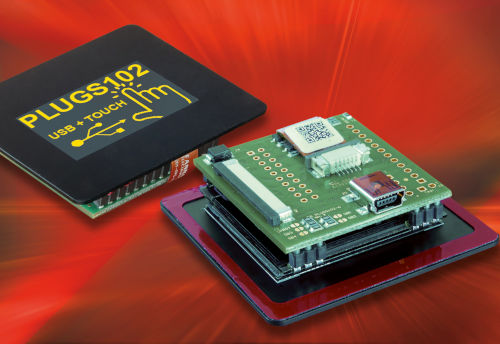
Its 36 x 25 mm viewing area offers a resolution of 102 x 64 pixels. Since each pixel in OLEDs represents a light source, this panel boasts incredibly bright colors, deep black levels, and strong contrast compared to any LCD screen.
All these characteristics are present from almost any viewing angle, up to 180°, because OLEDs do not exhibit the weak contrast typical of LCDs at oblique viewing angles. A separate backlight is not required. The screen brightness can be adjusted via software. Automatic screensaver modes prevent potential burn-in of static images.
Thanks to the integrated USB interface, the OLED module can be put into operation quickly and easily. Simply plug it in, and the display will power on automatically. Data transfer is performed serially via USB, SPI, RS232, or I2C.
For measurement and control tasks, the EA PLUGS102-6 is equipped with eight freely configurable digital I/O interfaces, two analog inputs, and one PWM and one analog output. A small speaker is also integrated.
The EA PLUGS102-6 recognizes high-level, language-like graphical commands, which can be mastered even without prior knowledge. In addition to eight built-in fonts, the display also features a range of sophisticated graphical functions. There's no need for the time-consuming development of character sets and graphical routines. Text and graphical elements can be mixed and matched as desired, positioned with pixel precision, and provided with blinking attributes (on/off, reverse). Up to 256 images and the same number of macros can be stored in the internal memory.
The complete OLED module measures 55 x 54 x 15 mm. Its power supply voltage, if not supplied via USB, can vary from 3.3 to 5 V. With all pixels enabled, it typically requires 137 mA or 97 mA. Its operating temperature ranges from -20 to 70 °C. For quick mounting, it simply adheres vertically or horizontally to the front panel.




