




and as key elements of software-defined substations (SDS) to offer greater flexibility, scalability, ease of management and integration between different providers.
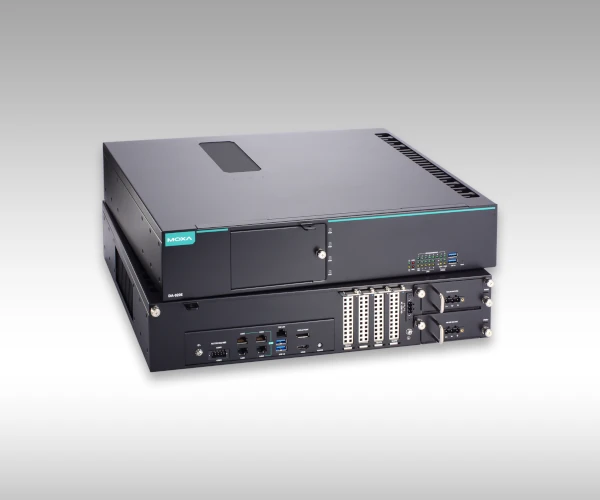
The power sector is undergoing a shift in the design of PAC systems, moving from hardware-centric devices to modular software components and open standards. vPAC is a key component of this transition, enabling protection, automation, and control functions to run as virtualized workloads on a shared, redundant platform. This, in turn, has driven demand for fanless, IEC 61850-compliant vPAC servers, such as the DA-920E series.
Fanless Thermal Design for Harsh Environments
Many modern substations are unmanned, especially those connected to distributed offshore wind farms or remote solar fields. Traditional high-performance servers often use mechanical fans, which can be a significant point of failure in environments with high levels of dust and heat. Utilities and system operators are looking for ways to address one of the industry's biggest challenges: how to increase automation and intelligence at the grid edge without increasing operational risk or maintenance burden.
By eliminating mechanical cooling fans, the Moxa DA-920E series removes one of the most common sources of hardware failure while improving long-term operational stability. A fanless solution in a sealed enclosure minimizes maintenance requirements and improves system availability, making it especially beneficial for substations located in remote deserts, offshore wind farms, mountainous areas, and other hard-to-reach locations.
High-performance computing without compromising reliability.
The DA-920E series is designed to maintain uncapped CPU performance, even at the maximum operating temperature (-25 to 55°C), and supports high-performance CPU options for demanding vPAC and substation-level workloads. The fanless, substation-ready vPAC server also delivers the deterministic performance required for mission-critical electrical applications, enabling utilities to host protection and automation applications on a virtualized infrastructure while maintaining operational reliability.
Designed for substation environments compliant with IEC 61850 and other industry certification requirements, such as IEC 60255, IEEE 1613, and EN 50121-4, the DA-920E Series fanless vPAC servers withstand challenges such as exposure to extreme temperatures, dust, humidity, vibration, electromagnetic interference, and unstable power conditions. With the DA-920E Series, operators can reliably extend their operations to remote, unmanned substations at the network edge, focusing on the edge computing platform of these substations as critical infrastructure.
As vPAC solutions move from proof-of-concept to field deployments, platform reliability is crucial for software-defined substations. While the physical limitations of IEDs do not restrict protection and control functions, they do require a robust computing platform. The DA-920E series integrates a fanless thermal design, high-performance computing, and IEC 61850-3 compliant endurance, providing a reliable foundation for vPAC systems and helping utilities modernize their substations.
Key features of the DA-920E Series, a fanless server compliant with IEC 61850-3
: ․ IT-grade virtualization performance
– Intel® Xeon® D CPU with 8 cores/16 threads
– Up to 256 GB of ECC memory capacity for optimal virtualization
․ Industrial-grade edge server platform
– Compliant with IEC 61850-3, IEC 60255, IEEE 1613, and EN 50121-4 substation standards
– 2U rackmount server with passive fanless cooling design
– (operating temperature range -25 to 55 ℃)
․ High-speed connectivity and flexible expansion
– 2.5 GbE LAN for three times faster cluster network transmission
․ High-availability redundancy
– Hot-swappable dual power redundancy
– RAID 0/1/5/10 storage redundancy



