




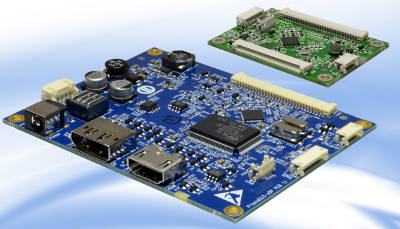
 “And it improves EMI performance with optimized power consumption,” comments Matthias Keller, COO of Components at Distec. “This is particularly relevant for midsize PCs, as the eDP interface is available on all current Intel and AMD chips, especially in the notebook/ultrabook segment. Therefore, eDP will officially replace LVDS on PC platforms this year.” In addition to the PRISMAeco-eDP range, Distec’s portfolio of smart eDP solutions includes the small LVDS2eDP interface. Integrated into the customer’s existing design, it simply converts the existing LVDS interface to eDP. This allows the customer to retain their controller solution and utilize one of the modern high-definition flat panel displays (e.g., 12.5”).
The powerful, cost-effective, and space-saving PrismaECP-eDP multimedia card
features HDMI and DisplayPort inputs. It quickly and easily controls TFT displays via the dual-lane EDP interface and currently supports resolutions from WSXGA (1600x900) to WUXGA (1920x1200). Backlight brightness can be controlled via pulse-width modulation (PWM) or analog voltage, and can also be automatically adjusted to ambient light conditions using an optional ambient light sensor.
A particular advantage of the PrismaECO-eDP is its ability to be individually tailored to application requirements. The unique ChandlerRover configuration software allows for port selection, timer settings, EDID programming, and numerous other adjustments. This is especially useful for system integrators, who can customize the PrismaECO-eDP for each client. Its OSD menu settings and configurations can be downloaded from the controller board's EEPROM and easily transferred to other boards. This enables rapid serial production of precisely configured TFT controller boards for a variety of applications. The PrismaECO-eDP thus serves as a universal foundation for customized projects with different TFT displays.




