




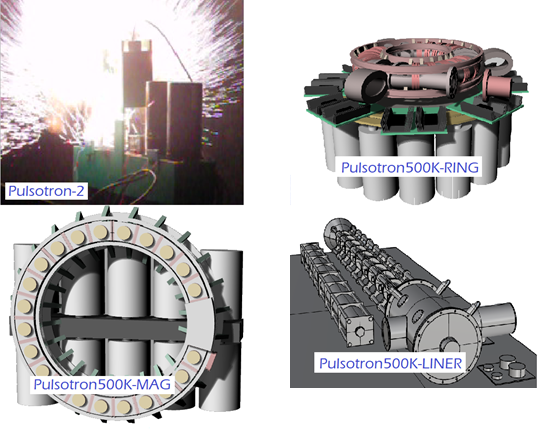
Just as a race car driver can't be without their car, a plasma scientist or engineer can't be without their reactor; therefore, we have put three reactors up for sale:
1. The Pulsotron 500K-MAG is a compact, toroidal reactor surrounded by coils and mounted on an improved Pulsotron-2 structure. It is designed to generate plasma at a record energy of 500 keV with peaks of 1 MeV, using various synchronized power stages that can deliver up to 22 megawatts to the target. This design also offers three other advantages that will allow the most skilled engineers and scientists to achieve ignition. Its compact design allows it to be installed in a room instead of a costly building (less than €42,000) at the distributor SETUP ELECTRONICA. Any university, technological institute, or company will be able to achieve ignition within 3 years, along with the related knowledge.
2. The Pulsotron 500K-MAG is also a toroidal container that accelerates plasma using high-frequency electromagnetic pulses. It is designed to inject between 500 and 1000 kiloelectronvolts into the plasma with its three stages and two electron anti-heating systems.
The various power stages can deliver pulses of 74 megawatts onto the target. Its compact design, less than 5 m², is designed, like the previous model, to achieve clean hydrogen fusion with lithium-6 or beryllium-7.
3. Our most extreme design, the Pulsotron 500K-LINER is currently our flagship and accelerates ions to 500KeV using high-efficiency single-shot electrostatic acceleration, employing a much-improved capacitor bank from Pulsotron-2 that will allow the release of 9 trillion watts for less than a microsecond.
The reduction in weight, size, and cost stems from the fact that the electron's weight is 1800 times less than that of ions, carrying away almost all the injected energy. Therefore, by preventing the electron from heating up, the reactor can be made thousands of times smaller, faster to operate, and brought to market more quickly.
Furthermore, the reactor can be used in other branches of high-energy physics, such as plasma diagnostics, plasma physics, sensors, and medical facilities.
The operators of our reactors will be included in a technology licensing program that will allow them to develop their own technology and patents based on our technology.
The Pulsotron project currently involves scientists from 7 countries, who collaborate in a global network.
Scientists can join the consortium until January 31, 2018, and companies until March 15.




