

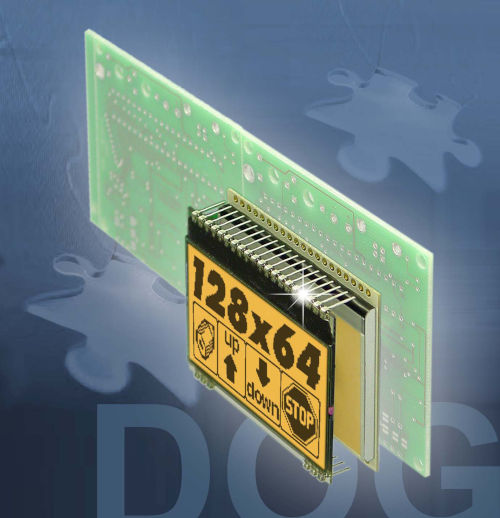
Designed as chip-on-glass displays, the controller is already integrated. The text displays come with built-in character sets. These high-contrast displays can be soldered directly to the printed circuit board. They operate on 3.3 V without auxiliary power, and current consumption ranges from 150 to 900 µA depending on the model and size. They are controlled via a 3- or 4-wire SPI or, in some models, even via a 2-wire I²C or a 4- or 8-bit data bus.
The text and graphic displays are currently available in 13 different sizes, from 55x31 mm to 94x67 mm. This includes six text displays with one to four lines and seven graphic displays with resolutions between 102x64 pixels and 240x128 pixels. Five high-contrast LCDs are available: reflective and transmissive STN, blue-backlit STN, and positive and negative black/white FSTN. The contrast ratio can be adjusted by dial. The graphic displays can also be rotated 180° for mechanical reasons or to improve readability, for example, for mounting on the front of a laboratory power supply. EA DOG displays can also be combined with a touchscreen.
For backlighting, the user can choose from six colors: white, yellow/green, blue, amber, red, and full-color RGB. Simply place the backlight behind the display and solder it to the printed circuit board containing the display. No additional mounting is required. The backlight is operated by an external series resistor or LED driver. Significant operation is possible from as low as 3 mA.
All panel variants are available as single units. DISPLAY VISIONS GmbH guarantees long-term availability for up to 10 years. This also ensures replenishment for long-term product lines.
A free simulator can be downloaded from the manufacturer's website. It allows you to simulate all display versions and colors on your Windows PC before purchasing. A USB breadboard is also available for easy setup with a real display. This allows you to directly display your own text on the connected screen. DISPLAY VISIONS also supports developers with comprehensive support and extensive C and microcontroller code.
DISPLAY VISIONS will be present at embedded world (hall 1, stand 389) in Nuremberg.