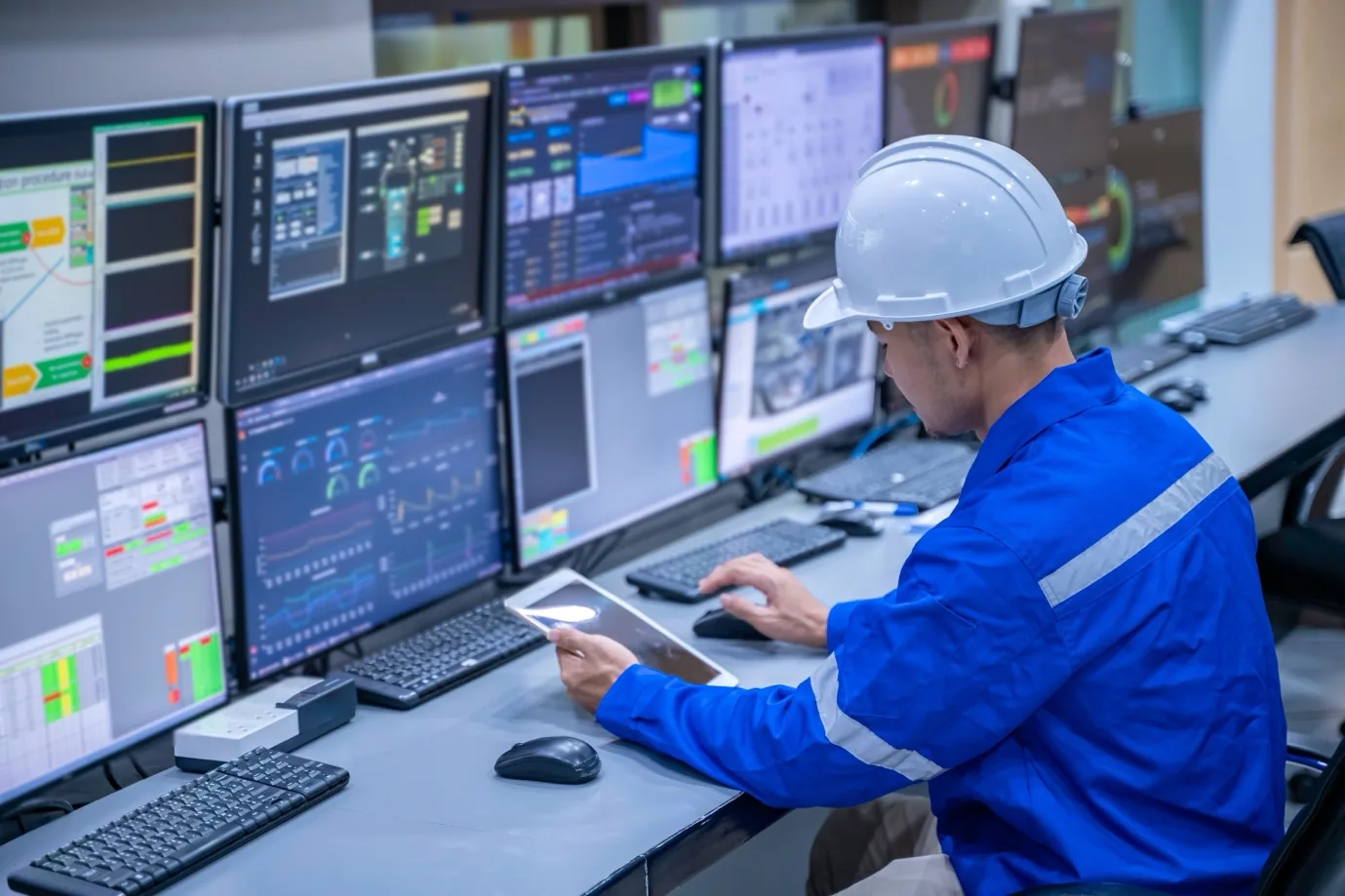
The latency of data traveling to and from the cloud can range from tens to hundreds of milliseconds on traditional enterprise networks, depending on the network path and distance.[2] This speed is too slow for real-time control and safety functions in industrial systems. Processing every event in the cloud also increases communication costs and introduces the risk of system outages when connectivity is poor.
Artificial intelligence (AI) at the edge addresses some of these limitations by running machine learning (ML) models directly on the hardware. This strategy allows systems to make decisions immediately without waiting for a remote server. In this week's New Tech Tuesdays, we explore how local processing is increasingly being used in industrial automation and machine vision systems, where immediate responses to sensor and image data are essential.
Beyond the proof of concept
In its early days, edge AI was the kind of technology seen only in controlled pilot projects or very specific hotspots. It was a technology designed to prove a concept, not for everyday use. That's changing rapidly. As the development of tools and hardware platforms advances, edge AI is moving out of the lab and into real-world, always-on production systems.
Much of this is due to the software. Today's edge platforms are better at speaking the same language as the rest of the AI ecosystem. They support common frameworks and runtimes, making it easier to migrate models from development to deployed systems. This compatibility also simplifies updating models when data or requirements change.
However, ease of deployment isn't the only important factor. Reliability is crucial, especially when systems are running around the clock. Keeping inference processing local means an AI device at the edge doesn't have to rely on a network connection to function. In environments like manufacturing plants or remote monitoring stations, this resilience provides convenience and can even be critical in some cases. If connectivity is lost, the system can continue operating.
Models on the edge are becoming smaller and more practical
Currently, one of the significant changes in edge AI is the trend toward smaller models. Instead of building the largest possible network, teams are focusing on models that can run on limited hardware. Techniques like quantization and pruning help eliminate excessive processing and memory usage and keep performance virtually unaffected.[3]
These types of optimizations are practical today because models that previously required powerful processors and generous memory budgets can now run on hardware that would have been out of reach just a few years ago. This helps bridge the gap between what works in research environments and what can be deployed in production plants and field equipment. Ongoing work in this area continues to show that significant reductions in footprint and processing power without sacrificing performance are possible.
Therefore, hardware constraints are decreasing. AI at the edge doesn't have to be confined to high-end servers located at the network edge. Engineers can implement real-time inference on more modest embedded boards and gateways, often within the same systems already handling control, monitoring, and communications. This flexibility makes AI at the edge more applicable across a wider range of industrial systems.
Reducing data movement is becoming a key factor
Another trend driving AI adoption at the edge is the cost of moving data.[4] Sending high-resolution sensor data streams or raw machine vision frames back to the cloud is slow, bandwidth-intensive, and can quickly become expensive. At scale, these costs can outweigh the benefits. As a result, more and more organizations want to manage data closer to where it is generated.
By filtering, summarizing, or classifying data locally, edge AI systems reduce the load on both networks and storage systems in the early stages. With less reliance on remote infrastructure, edge AI deployments are better equipped to continue processing data during network slowdowns or temporary outages.[5]
The newest products for your most innovative designs®
The Advantech AOM-2721 development kit is an embedded computing platform designed for evaluating AI at the edge. It incorporates a Qualcomm QCS6490 system-on-a-chip (SoC) with up to eight Kryo cores running at up to 2.7 GHz, an integrated vision processing unit (VPU) and graphics processing unit (GPU), and 8 GB of high-speed LPDDR5 memory.
The board includes common industry interfaces such as PCIe Gen3, USB 3.2, Gigabit Ethernet and MIPI-CSI camera inputs, along with HDMI, DisplayPort and LVDS for displays (Figure 1), making it suitable for embedded and vision-centric AI tasks.

Figure 1: Block diagram of the Advantech AOM-2721 development kit (source: Mouser Electronics)
The conclusion
Edge AI has become an indispensable requirement for industrial systems that need rapid response, predictable behavior, and lower data movement costs. As models shrink and edge hardware continues to improve, teams can move beyond proof-of-concept work and deploy them in production systems. This technology is also changing how engineers approach development.
Platforms like the Advantech AOM-2721 allow for the evaluation of AI workloads at the edge earlier in the design process, so they aren't treated as an add-on. With early integration, teams designing automation systems can transition from testing to real-world operation without drastic redesigns.
Sources
[1]https://explodingtopics.com/blog/data-generated-per-day
[2]https://blog.equinix.com/blog/2021/08/09/cloud-vs-edge
[3]https://www.tensorflow.org/model_optimization/guide/pruning; https://www.edgeimpulse.com/blog/7-tips-for-optimizing-ai-models-for-tiny-devices
[4]https://www.cloudoptimo.com/blog/the-true-cost-of-cloud-data-egress-and-how-to-manage-it/
[5]https://azure.microsoft.com/en-us/resources/cloud-computing-dictionary/what-is-edge-computing
Article provided by Mouser Electronics, https://www.mouser.com