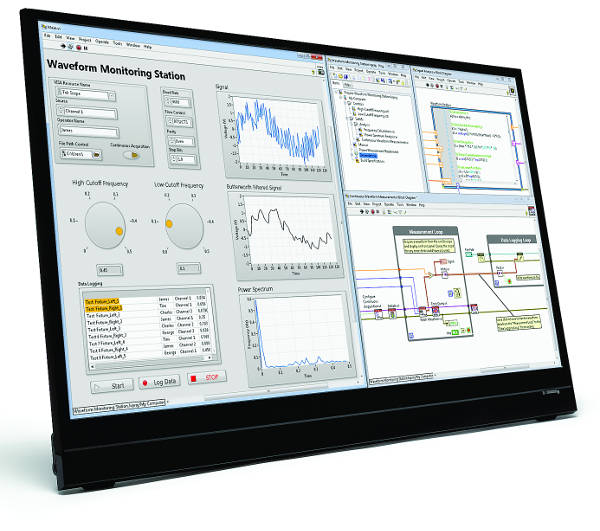
Christopher Relf, chief engineer at VI Engineering, commented, “The new channel cables in LabVIEW 2016 allow us to develop applications even faster by creating architectures that are transferable across different domains.” “With channel cables, we can establish sophisticated software architecture patterns that natively have multiple sources, without having to create and maintain a significant amount of custom software in the background.”.
Much of the success LabVIEW users have experienced is based on the openness of both the product itself and the ecosystem that supports it. LabVIEW 2016 continues this trend with improved interoperability with Python and third-party devices. This openness, combined with several enhancements, helps users continue to improve productivity by streamlining code development and deployment. With the latest version of LabVIEW, users can:
◾Simplify development with new channel wires that reduce complex asynchronous communication to a single wire.
◾Efficiently use RAM with new support for 64-bit plugins for; LabVIEW Control Design and Simulation Module, LabVIEW MathScript Real-Time Module, LabVIEW Unit Test Framework Toolkit, LabVIEW Desktop Execution Trace Toolkit, and LabVIEW VI Analyzer Toolkit
◾ Streamline bench measurement automation with the Instrument Driver Network, which supports 500 new devices in addition to the 10,000 existing instruments
◾ Integrate Python code using the new Python Integration Toolkit for LabVIEW, a simple programming interface (API) from Enthought, Inc. (available on the LabVIEW Toolkit Network) that can integrate Python scripts into LabVIEW applications
LabVIEW 2016 is fully compatible with the latest NI hardware technologies for RF design and testing, integrated monitoring and control, and engineering training, including the second-generation signal vector transceiver, the NI PXI-6570 digital pattern instrument, the low-current NI PXIe-4135 source measure unit (SMU), the wireless-enabled CompactRIO programmable controllers, and the NI Educational Laboratory Virtual Instrumentation Suite (NI ELVIS) RIO control module.