




How to Deal with Complex Power Requirements:
Complex and compact electronic systems and products have driven the demand for increasingly smaller, more efficient, and cost-effective power systems. In trying to arrive at the best power system solution, power designers have been forced to analyze perplexing topologies, architectures, and products. Each alternative design approach requires performance calculations, datasheet searches, manual thermal simulations, projections, design and encapsulation studies, bill of materials (BOM) generation, and cost analysis. To address this challenge, a variety of power design tools have been developed. These tools, however, do not allow for the analysis of the entire power system. Rather, the "front-end"—the filters and power conditions received from an AC or DC source—must be configured and analyzed separately from the plurality of downstream regulators that generate the voltages required by the system loads. Furthermore, these tools do not provide a complete modular solution: the resulting power system solutions combine a limited number of modular electrical devices with various "discrete" circuit solutions, each requiring dozens of components. Thus, power density is compromised, and the designer faces the challenge of determining the correct combination of front-end and DC-DC power system, while also addressing the complexities of discrete power circuit design, thermal control, packaging, and cost.
Simplifying the Complexity of Power Design:
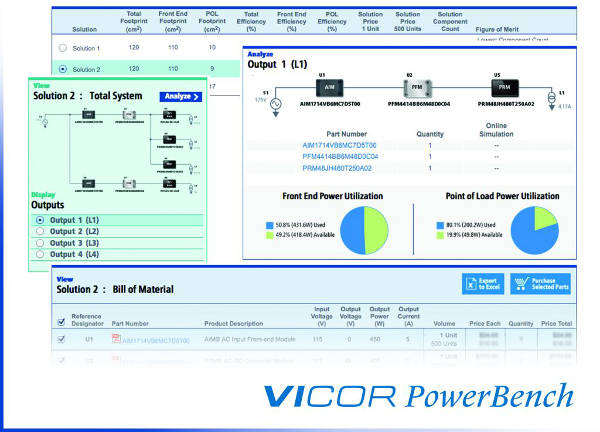
Vicor's online power system design tool simplifies and accelerates the creation of modular, compact, multi-output power systems, from the input source (AC or DC) to the system loads. Engineers simply specify their AC or DC input source and operating range, the required output voltages and respective power (or current), regulation and isolation specifications, and the tool automatically generates and identifies the best alternative solutions. Each solution is characterized by merit factors, including higher operating efficiency, fewer components, lower cost, and smaller footprint. Each solution can be viewed, analyzed, and optimized using Vicor's fully editable Whiteboard tool, enabling designers to meet the demanding performance requirements of the target application. For any selected design, the power system designer tool can display a visual representation of the system's mechanical layout and generate a complete bill of materials along with order and pricing information.
Vicor's new online feed system design tool makes feed system design easier by enabling complete specification, analysis, and configuration of multiple output feed systems with unprecedented performance, efficiency, and density in just minutes.



