




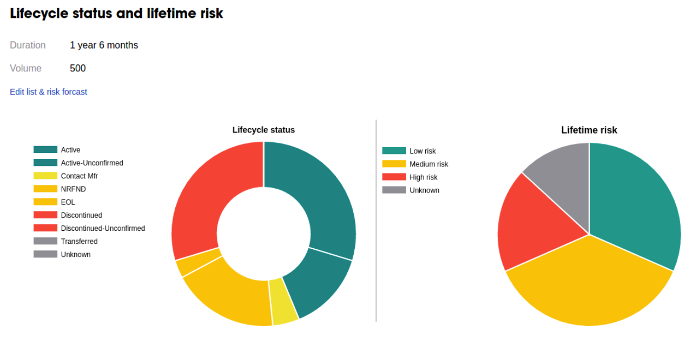
Each year, thousands of individual parts and components reach the end of their life cycle and become obsolete. End-of-life (EOL) notices carry substantial costs, as they often require products to be redesigned or restructured. Significant product delays can also occur, along with increased procurement and inventory handling expenses.
 All electronic and automation components will inevitably reach end-of-life (EOL), but the speed at which they become obsolete can vary considerably. While many companies may have prepared for this eventuality—by incorporating flexibility into their designs, for example, allowing them to accommodate the volatility of component supply—many are also at risk from the harsh consequences of obsolescence. Finding a viable replacement component can be time-consuming. In most circumstances, a replacement part will need to be at least as good as the original in terms of specifications such as footprint, pinout, power consumption, and heat dissipation, among others.
To address the challenges of component end-of-life, RS has developed 'Obsolescence Manager', a completely free tool for assessing component lifecycle risk. Specifically designed to enable engineers and purchasing managers to proactively monitor and manage the risks caused by obsolescence, the tool will initially assist engineers creating new electronic designs and can be expanded to cover the industrial sector, including the design of new panels and assembly line machinery.
The benefits for customers using this effective lifecycle management tool are numerous, such as being able to quickly obtain a bill of materials or parts list available in RS, thereby reducing the risk of obsolescence. Customers can also anticipate end-of-life issues for components based on project timelines, and find solutions for hard-to-find parts. Overall, the tool can reduce production and manufacturing costs and ensure faster time to market through increased design efficiency.
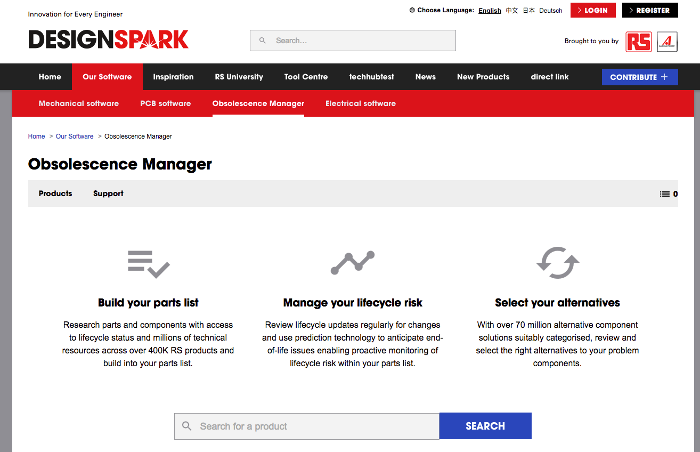 The tool offers a wide range of features, including product lifecycle status: for example, whether components are 'Active', 'Not Recommended for New Designs' (NRFND), 'Obsolete' or 'Last Possible Buy' (LTB), as well as the estimated years until end of life (YTEOL). The tool will also list parts that are alternative products in form, fit, and function, as well as whether they are direct replacements or similar.
The tool's component database will have access to 400,000 available products, including semiconductors, passive components, connectors, relays, power supplies, switches, and many other electronic and electrical devices. By mid-2017, we expect to add another 160,000 products. The database will also be compared against three million direct alternative products and 70 million functional and similar devices. The database will be updated monthly with changes recorded in the system.
Lindsley Ruth, Group Chief Executive of Electrocomponents, stated: "Product obsolescence presents a significant risk element for manufacturers, whether for new or existing designs; and it needs to be managed, especially considering the profound changes within the semiconductor market with many mergers and acquisitions, which also carry the risk of discontinuing many product lines," adding that "the 'Obsolescence Manager' tool delivers more power and control, and also allows for reducing the risks involved in the development of electronic products and systems.".
The 'Obsolescence Manager' tool is available on the DesignSpark website: www.rs-online.com/designspark/home




