




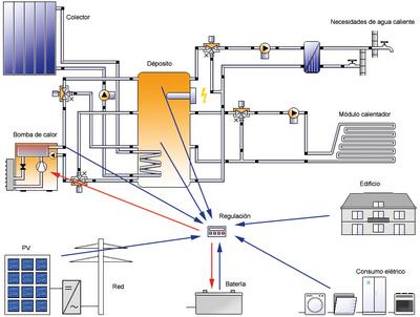
 This year's EU PVSEC Conference, held in Paris between late September and early October, served as the venue for presenting the results of several important research projects on optimizing photovoltaic self-consumption. These studies, the product of a collaboration between Vela Solaris and the Swiss Federal Institute of Technology Zurich (ETH Zurich), were funded by the Federal Office of Energy and Swisselectric Research. Now, just a few months after their initial publication, these results are available to a wide range of users with the Polysun 6.2 update. The simulations reveal the limitations and opportunities offered by these energy storage solutions, characterized by a combination of thermal storage and batteries, a topic currently the subject of much debate. Essential for achieving reliable results is the use of programmable regulations (available in Polysun since version 6.1) and realistic profiles (new in version 6.2: electricity consumption profiles with 15-minute time intervals). Depending on the type of solar installation, the type of building and the consumption profile, the user will be able to determine the optimal system, whether it is a heat pump with intelligent regulation or a battery solution.
Battery life depends on usage.
In close collaboration with the Power Systems Laboratory at ETH Zurich, battery lifespan was studied. Starting with version 6.2, the Polysun design tool supports battery sizing with a new battery model, displaying the battery's "state-of-health" (SOH) during simulation. The more and more frequently a battery is discharged, the lower its remaining lifespan becomes. Therefore, the following optimization problem arises during sizing: an undersized battery is cheaper, but with repeated deep discharge cycles, it will need to be replaced sooner. Within certain limits, it may be worthwhile to consider the additional costs of acquiring larger batteries, given their longer lifespan. With excessively large batteries, the initial investment will not be justified.
Calculating Off-Grid Photovoltaic Systems
: The growing demand for off-grid photovoltaic installations is a clear response to the high number of homes and residential complexes disconnected from the main electricity grid. Polysun 6.2 offers a tool to calculate the performance of off-grid systems, taking into account consumption profiles, meteorological data, and the technical characteristics of the module type, inverter, and battery. In just a few steps, Polysun provides the user with the annual performance results for the installation.
New features
in Polysun version 6.2:
• Consumption profiles in 15-minute intervals
• Rooftop photovoltaic module placement tool: improved ease of use, for example, thanks to the visualization of roof coordinates and integration into the sizing wizard
• Two-stage heat pumps
• New simulation model for cogeneration systems
• Off-grid photovoltaic installations
• Expanded battery component (battery charge regulation, battery life)
• Introduction of monthly heating requirement values
• New language: Arabic
New catalog and database updates
• 1741 new photovoltaic modules (worldwide)
• 154 new inverters (worldwide)
• 284 solar thermal collectors from the Solar Keymark and SPF databases (Europe)
• New products from Siko Solar, Schweizer Metallbau, Hoval, Vaillant, Saunier Duval, Sirch Tankbau, etc.
New schemes and companies
• Siko Solar: Kombibox and T-Station
• Duval business hydraulic schemes
• Hoval business hydraulic schemes



