



RSS feed

- Details
- Category: Other Equipment
Yamaha Motor Europe today announced that on July 1, 2021, it will launch the YRi-V 3D hybrid automated optical inspection (AOI) system, which achieves both high speed and high operating accuracy, for high-end factories assembling electronic components.
- Details
- Category: Embedded Systems
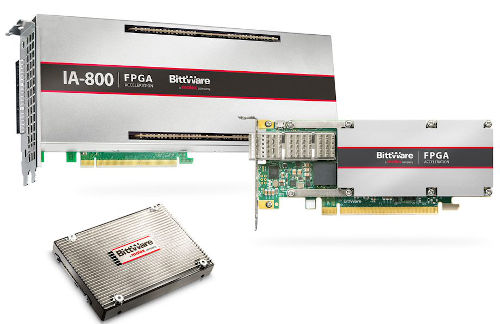
BittWare announces the expansion of its IA Series of accelerators based on Intel® Agilex™ FPGA devices. BittWare's IA Series FPGA accelerators are designed to help customers develop and deploy next-generation applications at the edge and in the cloud with greater flexibility and speed, while also reducing risk.
- Details
- Category: Technology
Imagine flexible surgical instruments that can rotate in all directions like miniature octopus arms, or how about large, powerful robotic tentacles that can work closely and safely alongside human workers on production lines? A new generation of robotic tools is beginning to become a reality thanks to a combination of strong "muscles" and sensitive "nerves" created from smart polymer materials.

- Details
- Category: Technology
The rapid growth of the electric vehicle market has driven the development, manufacturing, and sales of batteries, especially lithium-ion batteries. Meanwhile, interest in solid-state batteries has attracted the attention of material suppliers, battery vendors, component suppliers, automotive OEMs, and investors.

- Details
- Category: Integrated Circuits
Toshiba Electronics Europe GmbH (“Toshiba”) has once again expanded its optoelectronics catalog with the new TLP4590A photo relay, supplied in a compact DIP6 package, providing engineers with a more practical and reliable alternative to conventional mechanical relays.
- Details
- Category: Lighting
2020 and 2021 were the breakout years for Mini-LED displays. From Samsung to LG, TCL to BOE, Konka to Hisense, all these players launched their Mini-LED-based product lines. Apple also includes this technology in its upcoming product lines. The takeoff of backlit Mini-LEDs has also paved the way for Micro-LED displays, with large signage displays and televisions leading the initial adoption. The IDTechEx report, "Micro-LED Displays 2021-2031: Technology, Commercialization, Opportunity, Market and Players," provides a more in-depth analysis.
- Details
- Category: Integrated Circuits
Designers can now improve system reliability in low-voltage IoT applications with the Essential Analog nanoPower MAX16162 supervisor IC with fail-safe power-up from Maxim Integrated Products, Inc. This supervisor IC is the industry's first to fully assert a system reset across the entire system power ramp, thereby eliminating low-voltage power-up failures and delivering greater system reliability.

- Details
- Category: Sensors
SICK introduces the new TMS-TMM22x sensor, which measures tilt in one or two dimensions. The TMS-TMM2xx measures tilt, simplifying leveling and tilt measurement tasks in both the solar energy industry and mobile machinery.

- Details
- Category: Embedded Systems
MikroElektronika (MIKROE) introduces SiBRAIN, a standard for add-on development boards that simplifies the installation and interchangeability of a microcontroller (MCU) on a development board equipped with the SiBRAIN socket. SiBRAIN allows embedded system designers to test different MCUs in a prototype system without having to invest in expensive hardware or learn new tools.

- Details
- Category: Integrated Circuits
Power Integrations introduces the LinkSwitch™-TNZ, a new power supply switching IC that combines offline power conversion, lossless Zero-Cross detection, and optional X-capacitor discharge functions in a compact SO-8C package. The highly efficient LinkSwitch-TNZ IC can be used for non-isolated buck and buck-boost power supplies with up to 575 mA output current and provides up to 12 W output for universal-input isolated flyback designs.
Adnaan Lokhandwala, product marketing manager at Power Integrations, states: “The new LinkSwitch-TNZ ICs provide a precise signal indicating that the sinusoidal AC line is at zero volts. This signal is used by smart home and building automation products and devices to control the switching of relays, IGBTs, and TRIACs to minimize switching voltage and system input current. LinkSwitch-TNZ Zero-Cross point detection consumes less than 5 mW, enabling systems to reduce quiescent power losses compared to alternative approaches that require ten or more discrete components and consume 50 to 100 mW of continuous power.”.
Devices such as light switches, dimmers, sensors, and outlets periodically connect and disconnect the AC line using a relay or TRIAC. A discrete circuit is typically implemented to detect the zero-crossing of the AC line and control the power transition of the main power device, while simultaneously reducing switching losses and inrush current. This approach is component-intensive and has significant losses, consuming nearly half of the standby power budget in some cases. Similarly, household appliances often use a discrete zero-crossing detection circuit to control motor timing and the microcontroller unit (MCU). These applications also require an auxiliary power supply for functions such as wireless connectivity, door controllers, sensors, and displays.
LinkSwitch-TNZ ICs offer best-in-class light-load efficiency, enabling more system functions to be powered and meeting stringent standby regulations, such as the European Commission (EC) regulation for household appliances (1275), which requires equipment to consume no more than 0.5 W in standby or off mode; ENERGY STAR version 1.1 for Smart Home Energy Management Systems (SHEMS), which limits standby power consumption for smart lighting control devices to 0.5 W; and the Chinese standard GB24849, which limits microwave oven power consumption in off mode to 0.5 W. LinkSwitch-TNZ ICs also reduce the number of components by 40% or more compared to discrete designs.
Optionally, a capacitor discharge function X can be included in the package for high-power applications, allowing for reduced printed circuit board space, reduced bill of materials number, and increased reliability (LNK331x).
LinkSwitch-TNZ power supply switching ICs enable ±3% line and load regulation, no-load consumption of less than 30 mW with external bias, and IC standby current of less than 100 µA. The components are easy to design, feature integrated soft start, and operate with both isolated and non-isolated topologies.
Availability and Resources:
LinkSwitch-TNZ power supply switching ICs are priced at $0.84 in volume for 1,000 units. Four reference design examples are available for download. DER-874 and RDR-866 are non-isolated buck designs providing 6V/80mA and 5V/500mA outputs, respectively. RDR-877 describes an isolated 12V/0.5A output flyback with a ZCD signal on the secondary side, while DER-879 describes an isolated 12V/0.75A and 5V/0.2A flyback with ZCD and an integrated capacitor discharge circuit. For more information, contact a Power Integrations sales representative or one of the company's authorized worldwide distributors: Digi-Key, Farnell, Mouser, and RS Components.

- Details
- Category: Integrated Circuits
ROHM's AC/DC converter ICs with a built-in 1700V SiC MOSFET, the BM2SC12xFP2-LBZ in the TO 263-7L package, are optimized for industrial applications in the field of auxiliary power supplies for streetlights, commercial air conditioning systems, general purpose inverters, and AC servomotors.
- Details
- Category: Liabilities
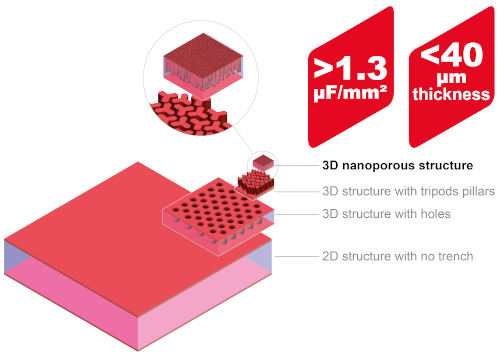
Murata has expanded its product offering for the mobile and high-performance computing (HPC) markets with the availability of its latest silicon process technology for manufacturing silicon capacitors with a density of 1.3 µF/mm². The extremely low ESL (low pH) and low ESR (low mΩ) of these devices support the high performance of new power distribution networks (PDNs) that require low impedance across a wide frequency bandwidth.

Spanish electronics magazine. Printed for over 25 years.
Spain - Madrid - All rights reserved © Convertronic Professional Spanish Electronics Magazine.